
12 best NPS software tools for different use cases
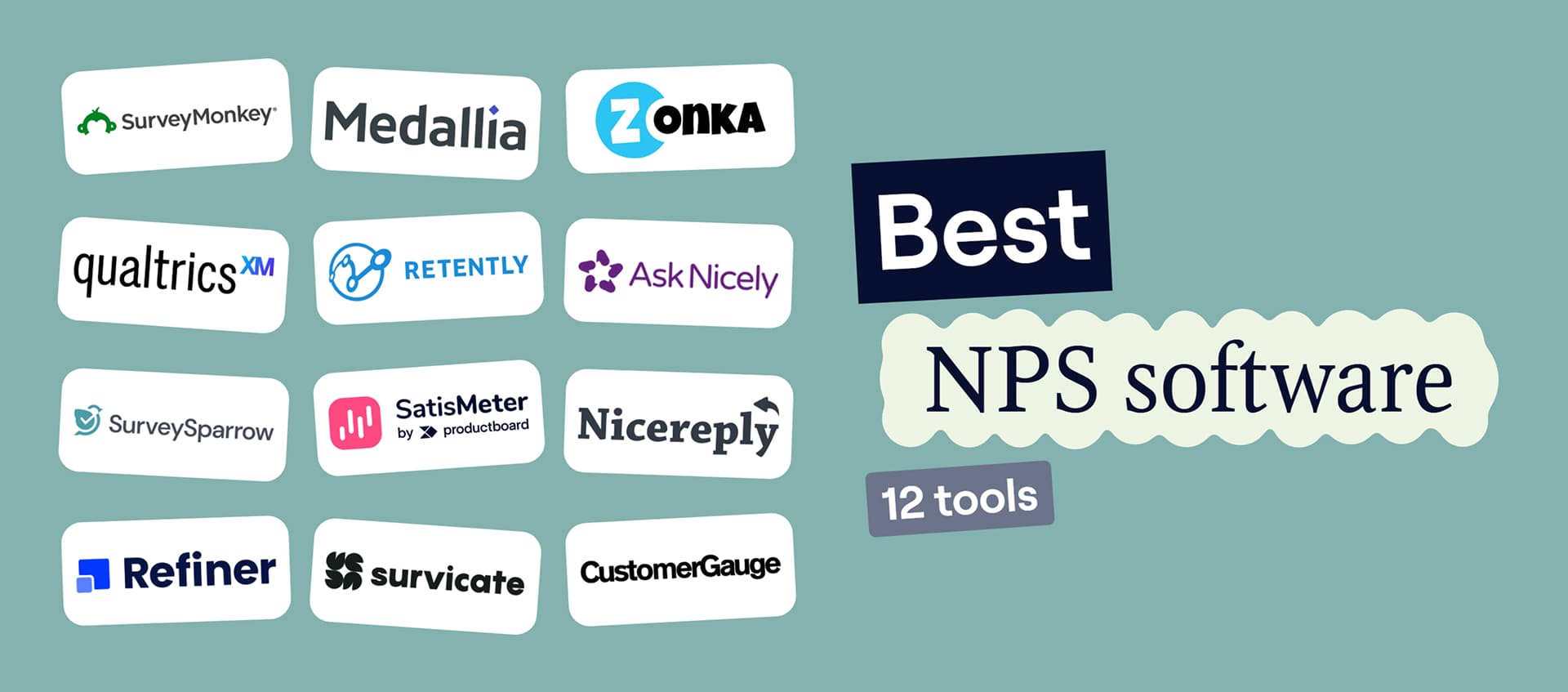
Net Promoter Score shows who’s likely to recommend you and who might leave, so you know who to ask for reviews and referrals, and who to win back. Teams usually face two problems: getting enough responses for a reliable score and linking scores to customer data. NPS software helps with both, but NPS survey tools differ in channels, integrations, analytics and follow-up. No single tool fits every team, so we’ve grouped 12 platforms by use case.
Quick answer
For SaaS teams, Refiner is the strongest pick for in-app NPS, while SatisMeter is simpler to set up.
Enterprises running large customer experience (CX) programs typically compare Qualtrics and Medallia.
B2B companies that need NPS per account should look at CustomerGauge.
Customer service teams get the most out of AskNicely or Nicereply.
If you need free NPS software to get started, Survicate and SatisMeter both offer free plans with 25 responses a month.
Best NPS software: quick comparison
The table compares the 12 tools at a glance. Prices are entry-level list prices from vendor sites as of November 2026, so check each pricing page before you buy.
| Tool | Best for | Survey channels | Key strength | Free plan / trial | Starting price |
| SurveySparrow | Multichannel NPS programs | Email, SMS, WhatsApp, web, mobile, link | Conversational surveys, recurring sends | Free plan + 14-day trial | From $19/mo; CX Suite on request |
| Survicate | Feedback across the customer journey | Email, link, website, in-product, mobile app | Fast setup, 25+ integrations | Free plan + 10-day trial | From $89/mo |
| AskNicely | Service and frontline teams | Email, SMS, WhatsApp, QR, in-app (top plan) | Frontline coaching and leaderboards | Demo | Custom quote |
| Retently | Automated NPS programs | Email, SMS, link, in-app, kiosk | Lifecycle automation, AI topic analysis | 14-day trial (7 days on B2B) | From $99/mo |
| Refiner | SaaS and in-app NPS | In-app (web, mobile), website, email, link | Behavioral targeting | 30-day trial, then free plan | From $149/mo |
| SatisMeter | Simple product and SaaS NPS | Web, in-app, email, iOS, Android | All features on every plan | Free plan | $199/mo |
| Zonka Feedback | Omnichannel customer feedback | Email, SMS, WhatsApp, web, in-app, kiosk | Location and agent reporting | Demo | Custom quote |
| CustomerGauge | B2B account-level NPS | Email, link, pop-ups (via partners) | Revenue-based NPS | Demo | From $24K/year |
| Qualtrics | Enterprise experience management | Email, SMS, web, in-app, mobile, QR | Research and analytics depth | Free account (limited) | Custom quote |
| Medallia | Enterprise CX programs | Surveys, digital, speech, social, video | Signal analytics at scale | Demo | Custom quote |
| SurveyMonkey | General surveys + NPS | Web link, email, website, social, QR, kiosk, mobile | Familiar builder, big template library | Free Basic plan | From $30/user/mo (teams, billed annually) |
| Nicereply | Customer support teams | Post-ticket email, email signature, link, website pop-up (beta) | Helpdesk integrations | 14-day trial | From $59/mo (billed annually) |
How we evaluated the NPS software
In November 2026, we reviewed each vendor’s product pages, help docs and pricing pages, then compared the tools on eight criteria. The reviews below focus on these criteria, so you can compare tools side by side instead of reading 12 sales pitches.
- NPS-specific functionality. Ready-made NPS templates, automatic grouping into Promoters (9–10), Passives (7–8) and Detractors (0–6), follow-up questions based on the score, and trend tracking over time.
- Survey channels. Where you can reach customers: email, web, in-app, SMS, mobile apps via an SDK (software development kit), links or kiosks.
- Segmentation. Filtering results by plan, region, customer type or behavior, so you can see which group pulls the score down.
- Analytics and reporting. Dashboards, NPS trends, comment analysis and shareable reports.
- Integrations. Native connections to the CRM, helpdesk and product analytics tools where your customer context already lives.
- Follow-up and closed-loop workflows. Alerts, task assignment and case management that make sure someone actually replies to a Detractor.
- Ease of setup. How fast a non-technical team can launch the first survey, and how much developer time in-app surveys require.
- Pricing and scalability. Whether there’s a free plan or trial, what the price depends on (responses, users or accounts), and whether that model fits your volume.
We signed up for free plans and trials where they were available, or went through the vendor’s product tour, and took all the screenshots ourselves. Retently, Zonka Feedback, CustomerGauge and Medallia didn’t give us self-serve access, so we reviewed them from their docs and product pages.
12 best NPS software tools in 2026
By the end of this list, you’ll have a shortlist of two or three tools worth testing with your own customers. Each review covers what the tool does best for NPS, where it falls short and what it costs to start.
1. SurveySparrow: best for multichannel NPS programs
Best for: teams that collect NPS on several channels and repeat surveys on a schedule.
SurveySparrow is known for chat-style “conversational” surveys. Its NPS, CSAT (customer satisfaction score) and CES (customer effort score) features sit in a separate CX Suite, a full NPS survey platform with recurring sends and follow-up workflows.
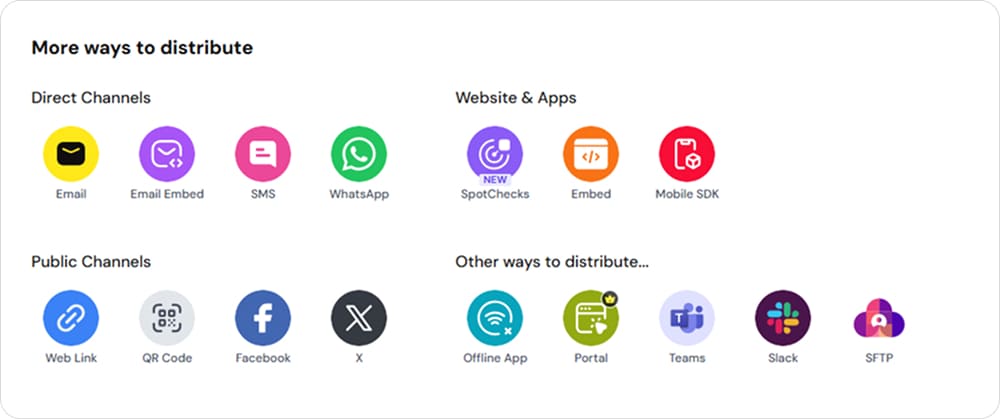
SurveySparrow distributes one survey by email, SMS, WhatsApp, link, QR code and website or app embeds
Key NPS features:
- Recurring NPS surveys that resend to the same contacts on a schedule
- Chat-style survey format instead of a classic form
- NPS dashboards with trends and filters by contact properties
- Workflows and webhooks to trigger follow-ups (Business and above)
- Tickets from survey responses with auto-assignment and SLA (service level agreement) rules
Survey channels: email, SMS, WhatsApp, web links and embeds, mobile SDK, offline kiosk.
Key integrations: Slack, HubSpot, Zendesk, Power BI.
Pros:
✅ One tool for NPS, CSAT, CES and general surveys
✅ Forever free plan to test the builder
Cons:
❌ The Surveys plans allow only one active CX survey, so a full NPS program usually needs CX Suite
❌ Pricing split across several products complicates budgeting
Pricing: forever free plan (75 responses per quarter) and a 14-day trial. Paid Surveys plans start at $19/month billed annually; CX Suite, which includes the NPS features above, is priced on request.
2. Survicate: best for collecting feedback across the customer journey
Best for: product and marketing teams that want NPS on the website, in the app and by email.
Survicate runs one NPS survey on your website, in your product, in a mobile app and by email. Setup is quick: build from a template or with AI, then publish via a code snippet, Google Tag Manager or Segment. For example, Kard collected more than 1,000 NPS responses in a day, redirected those who scored 9–10 to Trustpilot to leave a review and raised its rating there from 4.2 to 4.8.
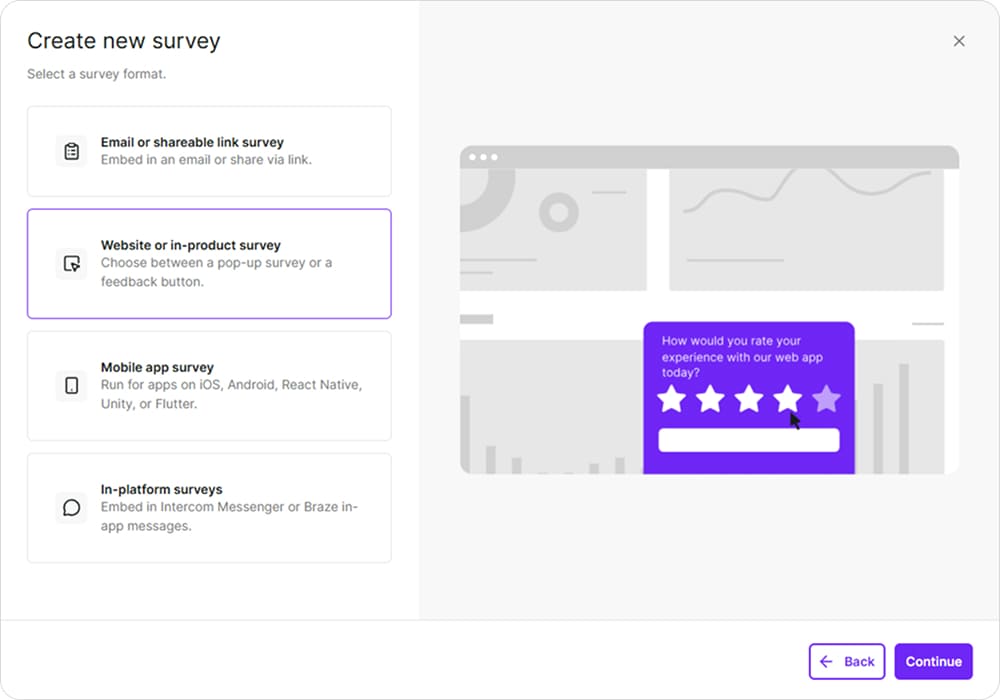
In Survicate, you pick the channel first: email or link, website, product, mobile app, or Intercom and Braze messages
Key NPS features:
- NPS templates with automatic score calculation and follow-up questions
- Targeting by URL and exit intent, by user attributes (Growth and above) and by events (Pro and above)
- AI categorization and sentiment analysis of open-ended answers (Growth and above)
- Recurring surveys and survey throttling (Growth and above)
Survey channels: email and link, website pop-ups, in-product, mobile app SDK, kiosk mode, QR codes, Intercom and Braze messages.
Key integrations: HubSpot, Intercom, Slack, Zendesk, Segment, Zapier, Salesforce, Mixpanel.
Pros:
✅ The same survey works across web, in-app and email
✅ Fast website launch without developer help
Cons:
❌ Key NPS automation (recurring surveys, attribute targeting) starts on Growth, which is billed annually only
❌ The free plan only covers a quick test
Pricing: free plan (25 responses a month) and a 10-day trial; Starter costs $89/month for 100 responses, and Growth starts at $114/month billed annually.
3. AskNicely: best for service and frontline teams
Best for: businesses where customer experience depends on frontline staff, such as home services, clinics, gyms and retail.
In a gym or a clinic, the customer experience is the person at the front desk. AskNicely collects NPS and CSAT right after a service visit and shows the feedback to the employee who provided the service, so managers can recognize good work and fix recurring problems.
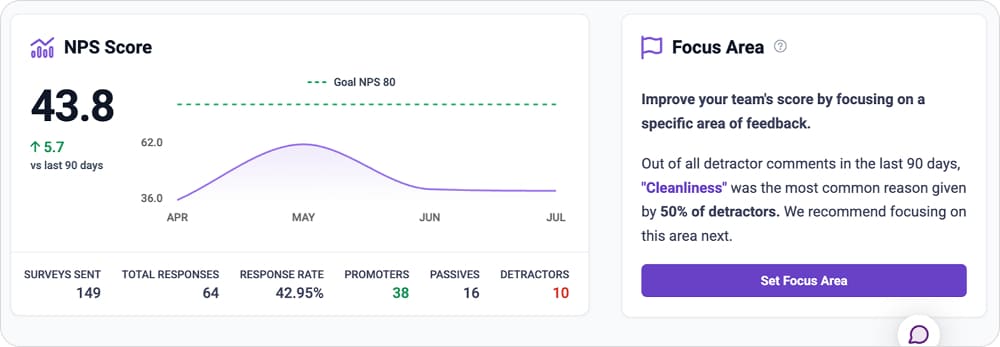
AskNicely tracks NPS against a goal and flags the top reason behind Detractor scores (Transform plan)
Key NPS features:
- Real-time NPS and CSAT feedback tied to individual employees and locations
- Automated workflows that alert managers about Detractors
- Reports and leaderboards by team, region and staff member
- Frontline coaching and team huddles (top plan)
Survey channels: email, SMS, WhatsApp, QR codes, in-app and mobile app surveys.
Key integrations: Salesforce, HubSpot, Zendesk, Zapier, Slack, Microsoft Teams.
Pros:
✅ Unlimited users on every plan
✅ Turns NPS into a daily routine for staff, not a quarterly report
Cons:
❌ Annual contracts with overage charges for extra responses
❌ No free plan; you start with a sales call
Pricing: custom quote on annual plans, starting at 500 responses and growing with volume.
4. Retently: best for automated NPS programs
Best for: ecommerce brands and B2B companies that want NPS to run on autopilot throughout the customer lifecycle.
Retently is customer NPS software with separate ecommerce and B2B plans. Connect your store, CRM or helpdesk, set campaign rules once, and Retently sends surveys at key moments, such as after delivery or a closed ticket.
Key NPS features:
- Automated recurring and lifecycle campaigns with reminders, follow-ups, delays and throttling
- Audience and feedback segmentation, trends and NPS benchmarks
- AI-powered sentiment and topic analysis of comments
- Account-level NPS and CSAT scores (B2B Pro and above)
Survey channels: email, link, embedded surveys, in-app web pop-up, feedback button, kiosk, SMS.
Key integrations: Shopify, Klaviyo, Gorgias, Zendesk, Intercom, HubSpot, Pipedrive, Salesforce.
Pros:
✅ NPS, CSAT and CES campaign automation from $99/month on Ecommerce Basic
✅ Ready-made integrations for ecommerce stacks such as Shopify, Klaviyo and Gorgias
Cons:
❌ No free plan, only a trial
❌ API and B2B CRM integrations start on the Pro plan
Pricing: 14-day free trial on ecommerce plans (7 days on B2B), no credit card required. Ecommerce Basic is $99/month (2,500 surveys, 3 seats) and Ecommerce Pro is $299/month; B2B plans start at $100/month.
5. Refiner: best for SaaS and in-app NPS
Best for: SaaS and product teams that want to ask for NPS inside the app at the right moment.
An NPS email sent to all users at once mixes people who signed up yesterday with power users who’ve been around for a year. Refiner avoids this with in-product microsurveys: install its JavaScript or mobile SDK, pass user traits, and show the NPS survey only to a specific segment, such as paying users active for at least a month.
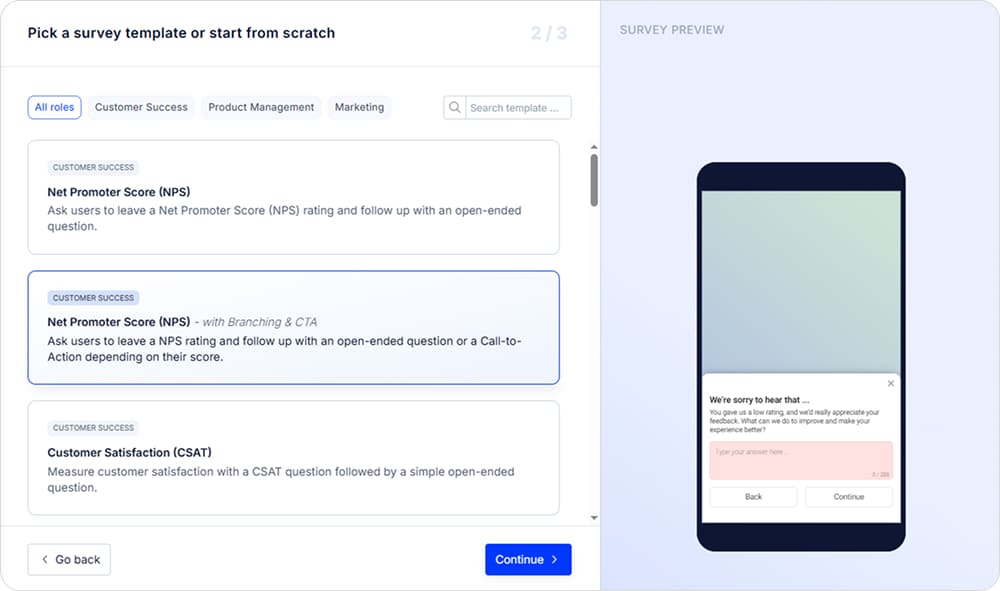
Refiner’s NPS template uses branching to ask unhappy users what went wrong and invite Promoters to leave a review
Key NPS features:
- In-app NPS widgets for web and mobile with custom design
- Segmentation by user traits, plus tracked behavior (Growth and above)
- Triggers by time, page visit or tracked event (event triggers: Growth and above)
- AI response tagging and NPS charts in reporting dashboards
Survey channels: in-app (web, iOS, Android, React Native, Flutter), website pop-up, email embed, survey links.
Key integrations: Slack, Microsoft Teams, Zapier, HubSpot, Salesforce, Segment, Mixpanel.
Pros:
✅ Precise targeting for in-app NPS
✅ Unlimited responses on paid plans
Cons:
❌ CRM and product analytics integrations require the Growth plan
❌ In-app surveys need a developer to install the SDK
Pricing: 30-day free trial (up to 100 responses), then a free plan with 25 responses a month. Essentials starts at $149/month and Growth at $279/month for 5,000 monthly active users, billed monthly; the price grows with your user base.
6. SatisMeter: best for simple product and SaaS NPS
Best for: small SaaS teams that want a lightweight in-product NPS workflow without heavy configuration.
SatisMeter is a focused tool for NPS, CSAT and CES, priced by the number of responses you receive. Instapage, for example, surveyed paying users two weeks after they subscribed and asked Promoters for reviews, which tripled its review count on G2, Capterra and Trustpilot.
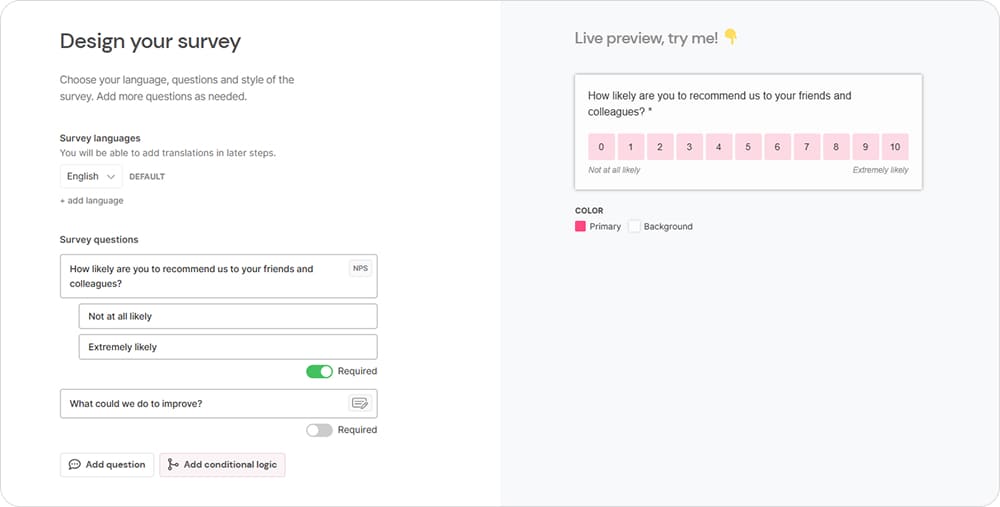
In SatisMeter, the NPS question, follow-up, language and brand colors fit on one screen with a live preview
Key NPS features:
- Event-based triggers and targeting by user attributes
- Automated recurring surveys with throttling and sampling to prevent over-surveying
- Read-only dashboard access via a link for stakeholders
- Multilingual surveys and custom design
Survey channels: web, in-app, email, iOS, Android.
Key integrations: Segment, Productboard, Intercom, Slack, Salesforce, Zapier.
Pros:
✅ Every feature on every plan, including premium support
✅ Unlimited projects, team members and surveys
✅ No overage fees: surveys pause when you hit the limit
Cons:
❌ Digital channels only, no SMS
❌ Steep jump from the free plan to Growth for small teams
Pricing: free plan with 25 responses a month, no credit card required; Growth is $199/month for 1,000 responses.
7. Zonka Feedback: best for omnichannel customer feedback
Best for: businesses with both digital and physical touchpoints, such as retail chains, clinics, banks and hotels.
Zonka Feedback collects NPS wherever customers are, from email and WhatsApp to a tablet at the checkout counter (even offline), and compares results across locations, channels and agents. Eyewear retailer SmartBuyGlasses reports that it increased NPS by 30% with Zonka Feedback.
Key NPS features:
- Comparison reports by location, channel and agent
- Case management to assign and resolve Detractor issues
- CX automation, real-time alerts and digest emails
- AI analysis of open-text feedback (add-on)
Survey channels: email, SMS, WhatsApp, website, in-product, mobile SDK, kiosk and offline app, links.
Key integrations: Salesforce, HubSpot, Zendesk, Freshdesk, Intercom, Slack.
Pros:
✅ Covers physical locations as well as digital channels
✅ Data hosting in the US, Europe, Australia or India
Cons:
❌ No public price list, so you need a quote
❌ Advanced AI analysis costs extra
Pricing: custom pricing based on response volume; you start with a demo instead of a self-serve trial.
Get lots
of leads — steadily
and affordably
A quiz delivers better results —
no extra ad budget needed

8. CustomerGauge: best for B2B account-level NPS
Best for: B2B companies with key accounts where several people at each client influence the renewal.
In B2B, one happy contact doesn’t mean a healthy account: the buyer may be a Promoter while daily users are Detractors. CustomerGauge handles this with Account-Centric NPS, which combines all respondents at one client into a single account score weighted by role. Revenue-Based NPS then links each account’s score to annual recurring revenue (ARR), renewal risk and expansion. One customer quoted on the vendor’s site reports that its NPS rose 16% and its closed-loop rate 8%.
Key NPS features:
- Account-level and revenue-based NPS
- Closed-loop workflows with time-to-close tracking
- Retention and churn-risk signals for each account
Survey channels: email and survey links; website and in-app pop-ups via partner tools such as Wisepops and Appcues.
Key integrations: Salesforce and other CRMs, API and webhooks.
Pros:
✅ The most B2B-specific NPS model on this list
✅ Priced by accounts, not responses: unlimited surveys, users and integrations
Cons:
❌ High entry price for small companies
❌ Narrow focus on NPS, so other research needs another tool
Pricing: flat platform fee from $24K a year, based on your account base and the modules you activate.
9. Qualtrics: best for enterprise experience management
Best for: large organizations that run several feedback programs at once, such as customer, employee, product and brand programs.
Qualtrics is an experience management (XM) suite where NPS is one of many metrics. Its strength is research depth: advanced survey logic, statistical analysis, text analytics and dashboards that combine NPS with operational data. It’s a good fit when NPS is part of a bigger CX research program, but overkill for a quarterly NPS email.
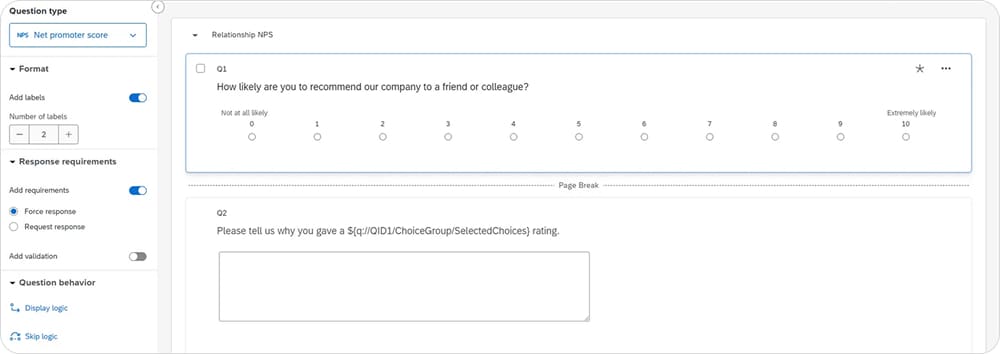
Qualtrics’ Relationship NPS template pulls the respondent’s score into the follow-up question, while display and skip logic decide which questions each respondent sees next
Key NPS features:
- NPS templates with driver analysis and text analytics
- Advanced segmentation and role-based dashboards
- Automated actions and closed-loop workflows
Survey channels: email, SMS, web, website and app intercepts, mobile, QR codes, offline.
Key integrations: Salesforce, Microsoft Dynamics, ServiceNow, Zendesk, Slack.
Pros:
✅ The deepest analytics and research toolkit on the list
✅ Scales to global, multi-brand programs
✅ Unlimited users and AI included in every product
Cons:
❌ Complex to set up and administer and usually needs a dedicated owner
❌ Quote-only pricing, and website, app and contact center feedback come as separate products
Pricing: free account with limited question types and responses; paid plans are quote-based and priced by interactions (survey responses, chats, calls, reviews), with unlimited users.
10. Medallia: best for enterprise CX programs
Best for: enterprises with huge volumes of customer interactions across stores, contact centers and digital channels.
Medallia captures signals far beyond surveys: contact center calls, chats, reviews, social media and digital behavior. NPS becomes one input in an operational system that routes insights to frontline teams in real time. Unlike lightweight tools such as SatisMeter, it’s built to run CX programs across global companies.
Key NPS features:
- Omnichannel feedback capture, including speech and text analytics
- Real-time alerts and action plans for frontline teams
- Role-based reporting with unlimited users
- Case management and closed-loop feedback
Survey channels: surveys, digital feedback, speech, social and video signals, with no extra charge per channel.
Key integrations: enterprise CRMs, contact center platforms and data warehouses via API.
Pros:
✅ Goes beyond surveys to calls, chats and reviews
✅ Used by 2,000+ brands, including 9 of the Fortune 10
Cons:
❌ Implementation usually takes months and needs internal resources
❌ No free plan or public pricing
Pricing: custom quote in annual tiers, priced by experience data records (EDRs); unlimited users, analytics and closed-loop workflows are included.
11. SurveyMonkey: best for teams that also need general surveys
Best for: teams that run NPS alongside market research, event feedback and employee surveys.
SurveyMonkey is a general survey platform with NPS support rather than dedicated NPS survey software. Add an NPS question to any survey, and SurveyMonkey calculates the score and splits respondents into Promoters, Passives and Detractors. That’s enough for an occasional check, not for an ongoing program with automated follow-ups.
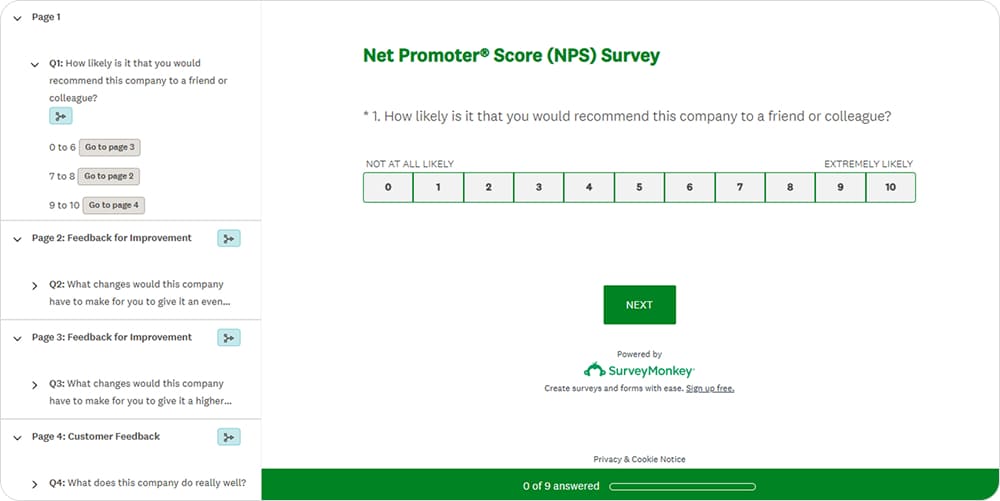
SurveyMonkey’s NPS template uses skip logic to send Detractors (0–6), Passives (7–8) and Promoters (9–10) to different follow-up questions on paid plans
Key NPS features:
- Filters and crosstabs (Premier plans) to compare NPS across groups
- Large library of survey templates
- Recurring surveys (Advantage and above)
- Global and industry benchmarks to compare your score
Survey channels: web link, social media, website embeds, email, QR codes, mobile SDK, pop-ups, kiosk mode.
Key integrations: Zapier, Slack, HubSpot, Mailchimp and 200+ other native integrations.
Pros:
✅ Familiar interface for both your team and respondents
✅ One subscription covers NPS and every other survey
Cons:
❌ No closed-loop case management for following up with Detractors
❌ Team plans require at least 3 seats and annual billing
Pricing: free Basic plan (you can view up to 25 responses per survey); team plans start at $30 per user a month, billed annually.
12. Nicereply: best for customer support teams
Best for: support teams that want to measure NPS, CSAT and CES inside their helpdesk workflow.
Support agents rarely hear how customers feel after a ticket is closed. Nicereply connects to helpdesk tools and sends a survey after a ticket is resolved or adds a rating to every agent’s email signature. Scores land in one dashboard by agent, team and channel, so support managers see who needs coaching and which issues create Detractors. It works best as NPS feedback software for support teams rather than as the foundation for a company-wide NPS program.
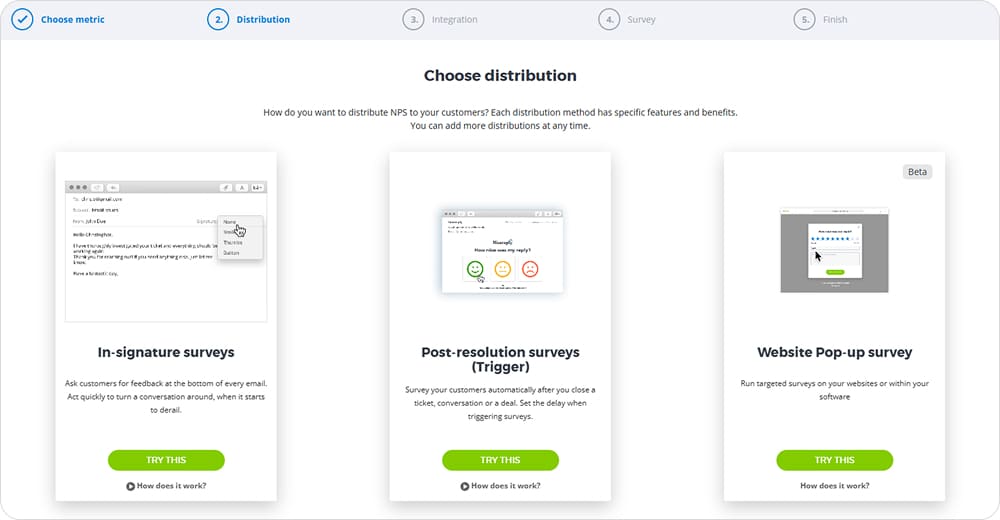
Nicereply sends NPS surveys in agents’ email signatures, after a ticket, conversation or deal is closed, or as a website pop-up
Key NPS features:
- Post-resolution and in-signature NPS, CSAT and CES surveys
- Automatic sync of responses back to the ticket
- Custom survey design with your branding
- Issues view that keeps every negative rating open until it’s resolved
- Helpdesk automation rules to follow up with unhappy customers
Survey channels: post-ticket email, email signature, survey link, website pop-up (beta).
Key integrations: Zendesk, Freshdesk, Help Scout, Front, Pipedrive.
Pros:
✅ All features and integrations on every plan
✅ You pay for responses, not for surveys sent
Cons:
❌ No free plan
Pricing: 14-day free trial, no credit card required. Starter costs $79/month, or $59/month billed annually, for 100 responses and 3 users.
Best NPS software by use case
If you know your main scenario, this table narrows the list to one or two tools. Then compare the shortlisted tools on integrations and price.
| Use case | Recommended tools |
| SaaS / in-app NPS | Refiner, SatisMeter |
| Customer service | AskNicely, Nicereply |
| B2B accounts | CustomerGauge |
| Enterprise CX | Qualtrics, Medallia |
| Multichannel surveys | SurveySparrow, Zonka Feedback |
| General surveys + NPS | SurveyMonkey |
| Lightweight feedback program | Survicate, SatisMeter |
FAQ

Key takeaways
📌 The best NPS software is not the platform with the most features. It’s the one that fits where you collect feedback, connects the score to the customer context you need and gives your team a clear way to act on Promoters, Passives and Detractors.
📌 Test before you commit: most tools here offer a free plan or trial, so run one real survey on your main channel first.
📌 For a lightweight scenario, like asking for a score after a purchase, a quiz builder such as Marquiz is enough. It can ask the 0–10 question, show Promoters and Detractors different follow-ups and send the answers to your CRM through 150+ integrations.