
50+ customer satisfaction survey questions with examples
What exactly do you want to evaluate? The answer should shape all your customer satisfaction survey questions. A general “Are you satisfied?” gives you a top-level signal, but it won’t tell you why a customer is happy or ready to leave. Questions about the product, onboarding, support, pricing, or your website point to the specific source of a good or bad experience. In this article, you’ll find 50 customer satisfaction questions grouped by stage of the customer journey, plus tips on which ones to pick and when to send them.
Customer satisfaction survey questions at a glance
Most customer survey questions fall into one of the nine groups below, depending on what you want to learn. Find the goal that matches your situation in the table, then jump to the full set of questions for that touchpoint. In the “Recommended format” column, CSAT stands for Customer Satisfaction Score: a short rating question about one specific experience, usually on a 1–5 scale.
| Goal | What to ask about | Recommended format | Sample question |
| Overall satisfaction | Overall experience | Rating / Likert | How satisfied are you with your overall experience with [company]? |
| Product satisfaction | Quality, usability, features | Rating + open-ended | How easy is [product] to use? |
| Onboarding | Clarity, ease, expectations | Rating + follow-up | How clear were the instructions for getting started? |
| Purchase experience | Checkout, delivery, communication | Rating | How easy was it to complete your order? |
| Customer support | Response, helpfulness, resolution | CSAT + follow-up | Was your issue fully resolved? |
| Website / app | Navigation, usability, friction | Rating + open-ended | How easy was it to find what you were looking for? |
| Pricing and value | Value for money, price perception | Likert / rating | How satisfied are you with the value you get for the price you pay? |
| Loyalty | Repurchase, recommendation | Rating | How likely are you to buy from us again? |
| Improvement ideas | Problems and expectations | Open-ended | What is one thing we could do better? |
A quick note on formats. A rating scale asks for a number, usually from 1 to 5, and gives you a CSAT score you can track over time. A Likert scale offers labeled answers, such as “Very dissatisfied” to “Very satisfied” or “Strongly disagree” to “Strongly agree,” and works well when you want customers to react to a statement. Open-ended questions let customers explain things in their own words. They add depth, but they take more effort to answer and to analyze, so they work best as follow-ups.
50 customer satisfaction survey questions
All customer satisfaction survey question examples below are grouped by touchpoint, the moment in the customer journey you want to evaluate. Each group explains why to ask these questions, gives you ready-made wording, and ends with a short tip on when to send them or how to read the answers. Replace the placeholders in square brackets with your company or product name.
General customer satisfaction questions
Use these questions for a regular check of overall customer sentiment, for example once a quarter or after a customer has been with you for a few months. The first questions show the general trend, and the last ones help you understand what drives it.
- How satisfied are you with your overall experience with [company]?
- How well does [product/service] meet your expectations?
- How does your experience compare with what you expected before you started?
- Which part of your experience are you most satisfied with?
- Which part of your experience needs the most improvement?
- What is the main reason for your satisfaction rating?
Tip: The simplest setup that works is one rating question plus one open-ended follow-up. It takes customers seconds to answer, and it gives you both a number to track and the reason behind it.
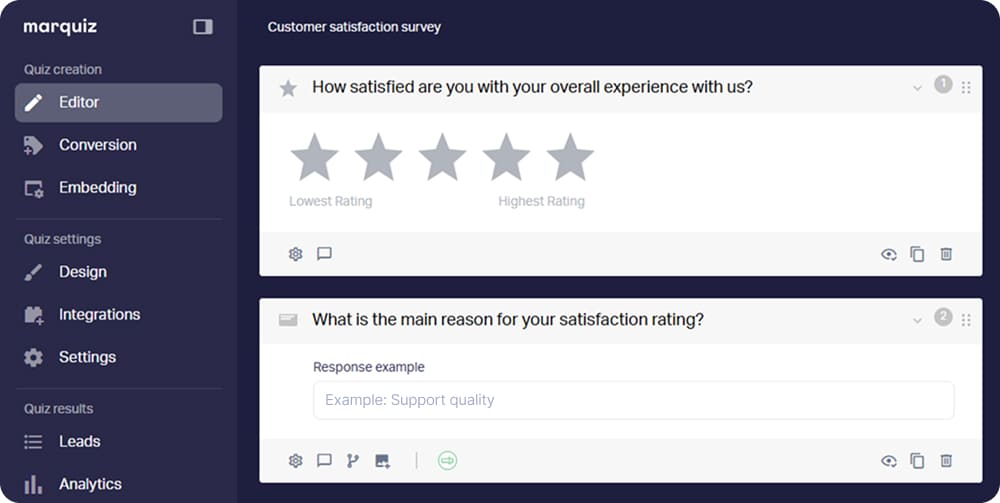
A rating question followed by a “why”: the stars show how satisfied the customer is, and the follow-up shows what shaped the score
Product satisfaction survey questions
Product satisfaction questions show whether the product itself delivers: its quality, usability, usefulness, the features people rely on, and the needs it still doesn’t cover. Send them to customers who have used the product long enough to form an opinion, not on their first day.
- How satisfied are you with [product] overall?
- How easy is [product] to use?
- How well does [product] solve the problem you bought it for?
- Which feature gives you the most value?
- Which feature is the hardest to use?
- If you could change one thing about [product], what would it be?
- Is there anything you expected [product] to do that it doesn’t do yet?
Tip: Read the answers to questions 4 and 5 together. If the same feature shows up in both, customers clearly need it, and making it easier to use will likely pay off faster than building something new.
Onboarding satisfaction questions
Onboarding questions matter most for SaaS products and services where customers need to set something up before they see results. They show how easy it was to start, whether the first steps were clear, how quickly the customer got the first result, and where friction appeared.
- How satisfied are you with your onboarding experience?
- How clear were the instructions for getting started?
- How easy was it to complete the initial setup?
- At any point during onboarding, were you unsure what to do next?
- What would have made getting started easier?
Tip: Send these questions right after the customer completes a key setup step, while the details are still fresh. If you wait a month, people remember only whether they eventually succeeded, not where they got stuck.
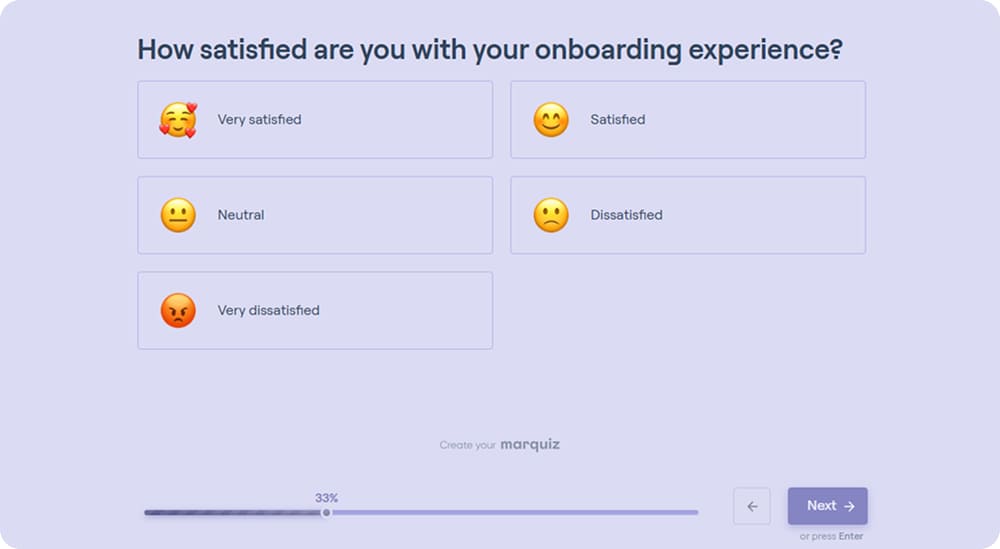
A labeled scale with emoji takes a second to answer
Purchase and checkout satisfaction questions
These questions fit ecommerce and other transactional scenarios. They cover the whole path: finding the product, checking out, paying, receiving the order, and comparing what arrived with what the customer expected.
- How satisfied are you with the buying process?
- How easy was it to complete your order?
- Did you have all the information you needed before making a purchase?
- How satisfied are you with the delivery of your order?
- What could we improve about the buying experience?
Instead of: “Were you happy with checkout and delivery?”
Ask: “How easy was it to complete your order?” right after checkout, and “How satisfied are you with the delivery of your order?” once the package arrives.
Why: A customer who breezed through checkout but got a late package can’t answer the first version honestly. Two questions at two moments give you two clear answers.
Customer service satisfaction survey questions
Customer service satisfaction survey questions evaluate a specific support interaction: how fast the team responded, how helpful and knowledgeable the agent was, how clearly they communicated, whether the issue was resolved, and how much effort it took the customer. This is the most common scenario for CSAT survey questions.
- How satisfied are you with your recent support experience?
- How easy was it to reach our support team?
- How satisfied are you with how quickly we responded?
- How clearly did our team explain the solution?
- How helpful was the person who handled your request?
- Was your issue fully resolved?
- What could we have done to make this support experience better?
Tip: Read question 6 next to the satisfaction rating. A customer can be happy with a polite, fast agent and still have an unresolved problem. If the issue comes back, a high rating won’t protect you from repeat tickets.
Instead of: “How much did you enjoy talking to our friendly support team?”
Ask: “How helpful was the person who handled your request?”
Why: “Enjoy” and “friendly” hint at the answer you hope to hear, so you’re more likely to get polite scores than honest ones.
Website and app satisfaction questions
Website satisfaction questions evaluate the digital experience: navigation, usability, and whether people managed to do what they came for. Ask about a specific visit or task rather than how customers feel about your interface in general, since abstract opinions about design are hard to act on.
- How satisfied are you with your experience on our website/app today?
- How easy was it to find what you were looking for?
- How easy was it to complete your task?
- Did anything stop you from doing what you came to do?
- What is one thing we could improve about the website/app?
Tip: Show these questions in context, for example after a completed task or when someone is about to leave a page. A short on-page survey catches the moment better than an email sent a day later.
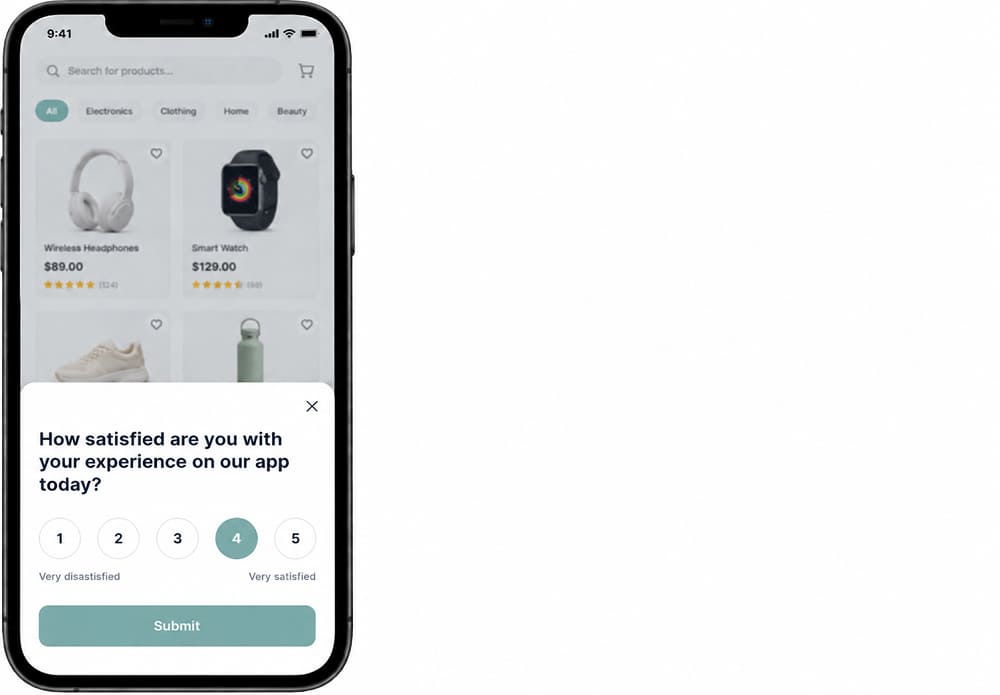
The word “today” ties the question to this visit rather than the app in general, so the answer is about something the customer just did
Pricing and value satisfaction questions
Price and perceived value are two different things. A customer can like your product and still feel it costs too much, so overall satisfaction may stay high while the perception of value drops. These questions help you separate the two.
- How satisfied are you with the value you get for the price you pay?
- How would you rate our pricing compared with the value of [product]?
- Does [product] provide enough value for your needs?
- Which part of [product] gives you the most value?
- What would make [product] feel more valuable to you?
Tip: If customers rate the product highly but give lower scores for value, don’t rush to cut prices. Often people simply don’t use the features they’re paying for, and better onboarding or clearer communication solves the problem.
Instead of: “Do you think our prices are too high?”
Ask: “How satisfied are you with the value you get for the price you pay?”
Why: The first version asks only about cost and practically invites a “yes.” The second asks customers to weigh price against what they get, which is the same choice they make when they decide to renew or leave.
Loyalty and retention questions
Customer loyalty questions measure what the customer plans to do next: buy again, keep using the product, renew a subscription, or recommend you to others. They work best with customers who have been with you for a while.
- How likely are you to keep using [product]?
- How likely are you to buy from us again?
- How likely are you to recommend us to someone with similar needs?
- What would make you more likely to stay with us?
- Is there anything that might make you switch to another provider?
Tip: Question 3 resembles the Net Promoter Score question, but NPS has its own standard wording, a 0–10 scale, and a separate formula. NPS and CSAT are different metrics, so report them separately. We compare them in more detail below.
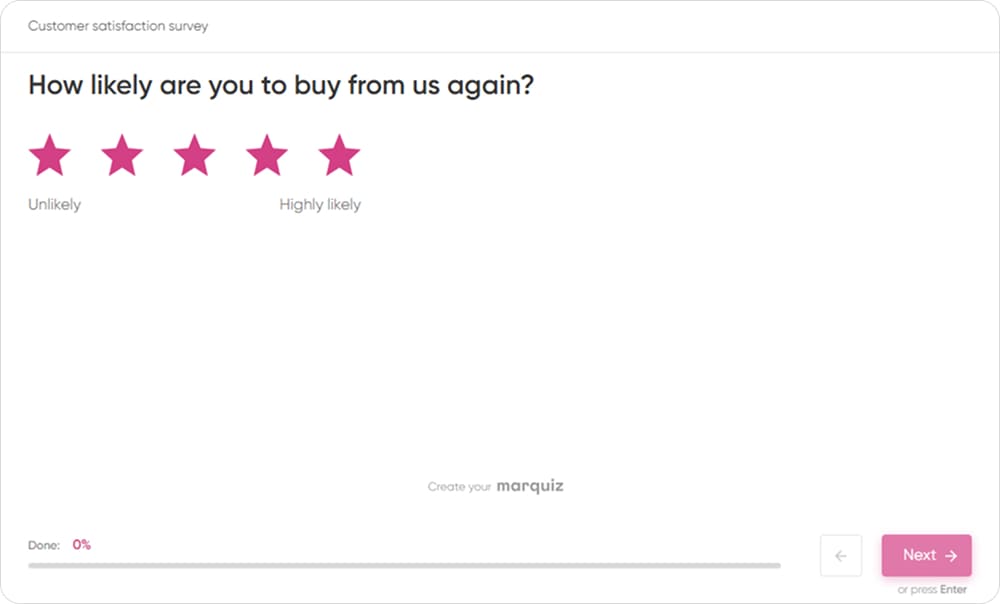
Satisfaction looks back, loyalty looks ahead: a customer can be happy today and still not plan to come back
Open-ended customer feedback questions
Open-ended customer feedback questions add context to the numbers. A rating tells you how a customer feels, and an open answer tells you why.
- What was the best part of your experience?
- What was the most frustrating part?
- What is one thing we could do better?
- What did you expect that you didn’t get?
- Is there anything else you’d like us to know?
Tip: Use open-ended questions as follow-ups rather than as the core of a long survey. They give you depth and sometimes insights you’d never think to ask about, but they take more effort to answer and more time to analyze. One or two per survey is usually enough.
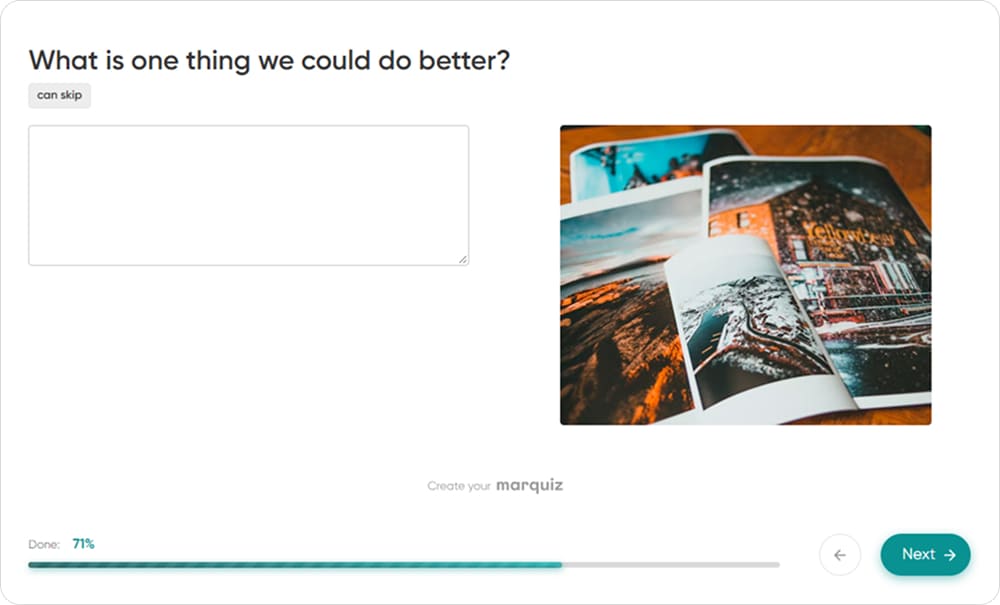
Make open-ended questions optional: customers who have something to say will answer, and the rest can move on instead of leaving the survey
Which customer satisfaction questions should you ask?
You don’t need all 50 questions. Treat the customer satisfaction question examples above as a menu, not a checklist: every extra question makes a survey longer, and people answer less of it. In Survicate’s 2025 benchmark of 8,392 surveys, surveys with 2–3 questions had a median completion rate of 86.8%, measured as the share of questions people actually answered. For surveys with 4–6 questions, it dropped to 77.4%, the biggest drop in the whole report.
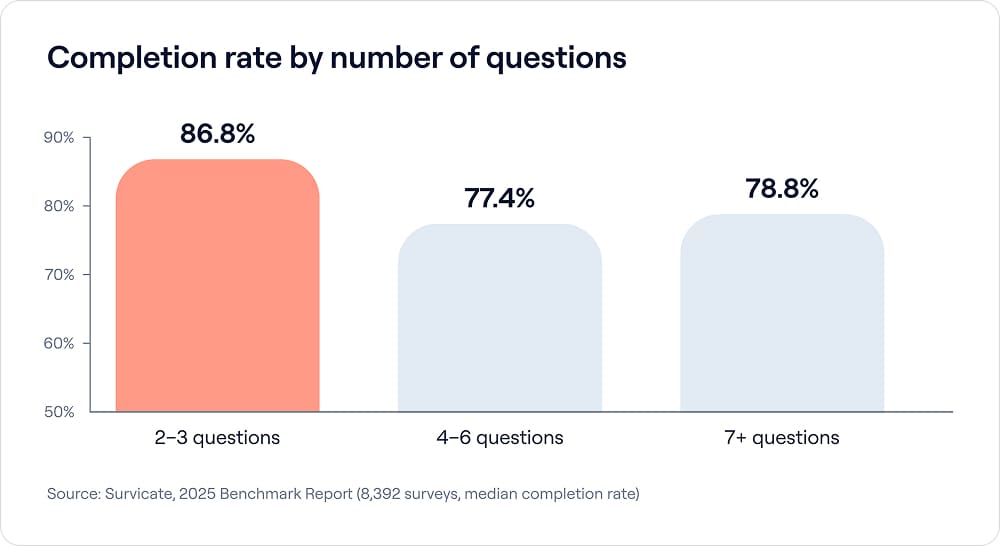
The slight uptick at 7+ appears only when all survey formats are combined; within each format, longer surveys keep losing answers
Start with the decision you need to make
Before choosing questions, name the problem the survey should help you solve. The problem tells you which group of questions to use:
- Onboarding conversion is falling → ask onboarding questions about clarity and the first steps.
- Customers keep contacting support about the same issue → ask about resolution and how clearly the solution was explained.
- Renewals are dropping → explore value, product fit, and the reasons customers consider leaving.
Say a SaaS team notices that 6 out of 10 trial users sign up but never finish setup. Instead of a 20-question survey, the team sends three questions only to the users who stopped halfway. The first asks them to rate the setup from 1 to 5, and the other two ask “At any point, were you unsure what to do next?” and “What would have made getting started easier?” Many answers point to the same step: people couldn’t figure out how to connect their CRM. The team adds a short hint right on that screen. Three questions were enough because the survey went only to people who got stuck, and it asked about one specific moment.
Match the question to the customer journey stage
Customers can only evaluate what they’ve just experienced, so tie each survey to a specific stage of the customer journey. Here’s what to focus on at each stage:
- After purchase: checkout and delivery.
- After onboarding: ease, clarity, and time to first value.
- After support: satisfaction, resolution, and effort.
- After ongoing use: product, value, and loyalty.
If a customer goes through several stages in a short time, resist merging them into one long survey: pick the stage that matters most for your current decision and save the rest for the next touchpoint.
Combine a score with a “why”
A rating on its own tells you that something went well or badly, but not what exactly. To find out, you don’t need a long survey. Often the most useful customer satisfaction questionnaire has just two parts:
- Quantitative: How satisfied are you with [experience]? (1–5)
- Qualitative: What is the main reason for your rating?
The score shows the trend, and the “why” shows what to fix. You can go one step further with branching. In a quiz builder such as Marquiz, a customer who rates the experience 1, 2, or 3 can get the question “What went wrong?” Those who give a 4 or 5 see “What did you like most?” instead. This way, each person answers a question that fits their experience.
Whatever you choose, every question should connect to something your team can understand, compare, or improve. If no one will act on the answer, cut the question.
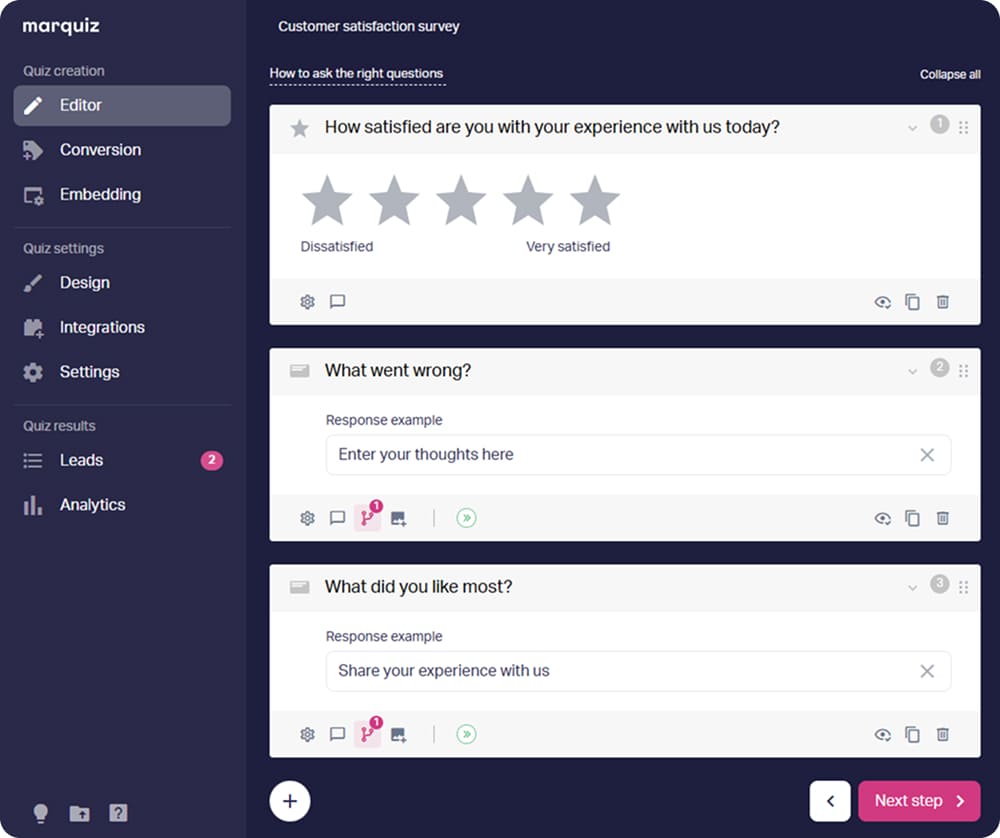
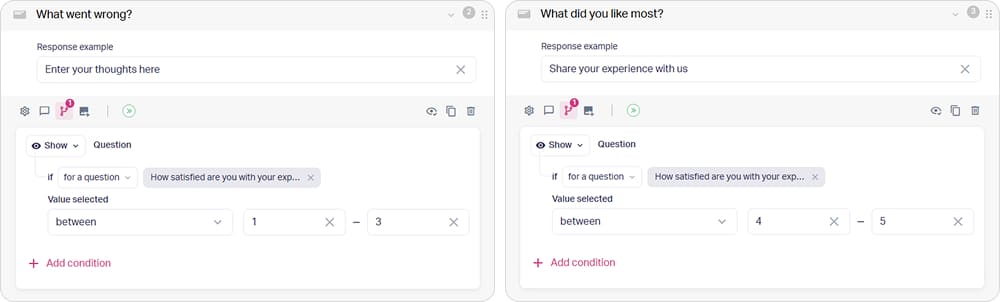
Use branching to set up the follow-up question: “What went wrong?” for low ratings, “What did you like most?” for satisfied customers
Here is one example from our own clients. A marketing agency that works with dental clinics sends patients a two-question quiz after a visit: how likely they are to recommend the clinic, and what they thought of the visit. Patients who liked it are invited to leave a review on the clinic’s business listing, while unhappy ones get a direct line to the clinic manager. The quiz doesn’t ask for contact details, so patients can answer anonymously. Only 1–2% of them go on to leave a review, but it adds up: one clinic holds a 4.9 average from 256 ratings over two years.
CSAT questions vs. NPS and CES questions
CSAT, NPS, and CES are the three most common customer experience metrics. They sound similar, but each one answers its own question, so decide which one you’re measuring before you write the survey.
⭐ CSAT (Customer Satisfaction Score) shows how satisfied a customer is with a specific experience: a purchase, a support ticket, onboarding, or a new feature. The typical CSAT question asks customers to rate their satisfaction on a 1–5 scale, and the CSAT score is the share of 4 and 5 ratings among all responses.
📣 NPS (Net Promoter Score) reflects the overall relationship and the customer’s willingness to recommend you. It uses one question, “How likely are you to recommend [company] to a friend or colleague?” on a 0–10 scale.
💪 CES (Customer Effort Score) shows how easy it was for the customer to complete a specific task, such as solving an issue with support. The authors who introduced CES in Harvard Business Review studied more than 75,000 people who had dealt with customer service reps or self-service channels. They found that CES predicted loyalty better than satisfaction measures or NPS, so it’s worth adding to support and self-service touchpoints.
| Metric | Main purpose | Typical use | Sample question |
| CSAT | Satisfaction | A specific interaction or experience | How satisfied are you with [experience]? |
| NPS | Loyalty and recommendation | The overall relationship | How likely are you to recommend [company] to a friend or colleague? |
| CES | Effort | How easy it was to complete a task | How easy was it to [complete a task]? |
These metrics don’t compete with each other. CSAT tells you how a particular interaction went, CES shows how much friction it involved, and NPS tracks the relationship over time. Many teams use them together, for example CSAT after each support ticket and NPS once or twice a year. If you’re choosing a tool for recommendation surveys, take a look at our overview of NPS software.
Get lots
of leads — steadily
and affordably
A quiz delivers better results —
no extra ad budget needed

When should you send a customer satisfaction survey?
The right timing depends on the experience you want to evaluate. The general principle is simple: ask close enough to the experience for the customer to remember it, but late enough for them to have something meaningful to evaluate.
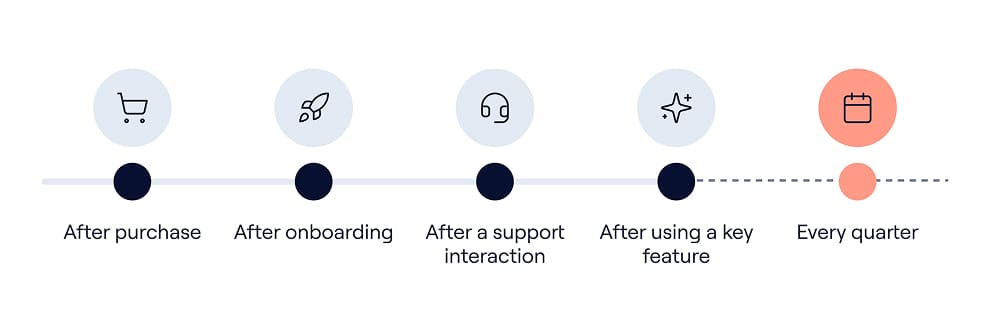
After a purchase. Send the survey once the customer has gone through the main purchase experience. For checkout, that’s right after the order. For delivery and product quality, wait until the order has arrived and the customer has had a chance to use it.
After a customer support interaction. Ask within a few hours, while the conversation is still fresh. Satisfaction ratings drift as the memory of an interaction fades, and late surveys skew toward customers who are motivated enough to still respond.
After onboarding. Send the survey when the customer has completed the key first steps, such as setting up an account or launching a first project. If you ask earlier, you get opinions about a process they haven’t finished.
After using an important feature or service. Trigger the survey by the event itself, for example after the third use of a new feature. This way you collect feedback on a specific experience rather than a vague impression.
At regular intervals. Run a short general survey every quarter or every six months to track how overall satisfaction changes. Keep the questions and the scale the same each time; otherwise, you won’t be able to compare the results.
One rule applies to every scenario: don’t survey the same customer after every single interaction. If someone gets three surveys in a week, they’ll likely stop answering all of them.
Key takeaway
The best customer satisfaction survey questions are tied to a specific experience and a decision you can make afterward. Start with a simple satisfaction rating, ask what caused that rating, and only collect feedback your team is prepared to analyze and act on.
FAQ