
15 best free quiz funnel examples & templates
Most websites still ask visitors for their details too early. Someone lands on a page, scrolls a bit, and gets a pop-up form before they know what they need or whether your product fits them. Quiz funnels flip that order: a few short questions first, then a relevant recommendation, and only then the contact form. I’ve seen many companies replace static forms with quiz funnels and get better leads and higher conversion rates.
Below are 15 real quiz funnel examples with free templates you can adapt, plus notes on when each type works and when it doesn’t.
What is a quiz funnel?
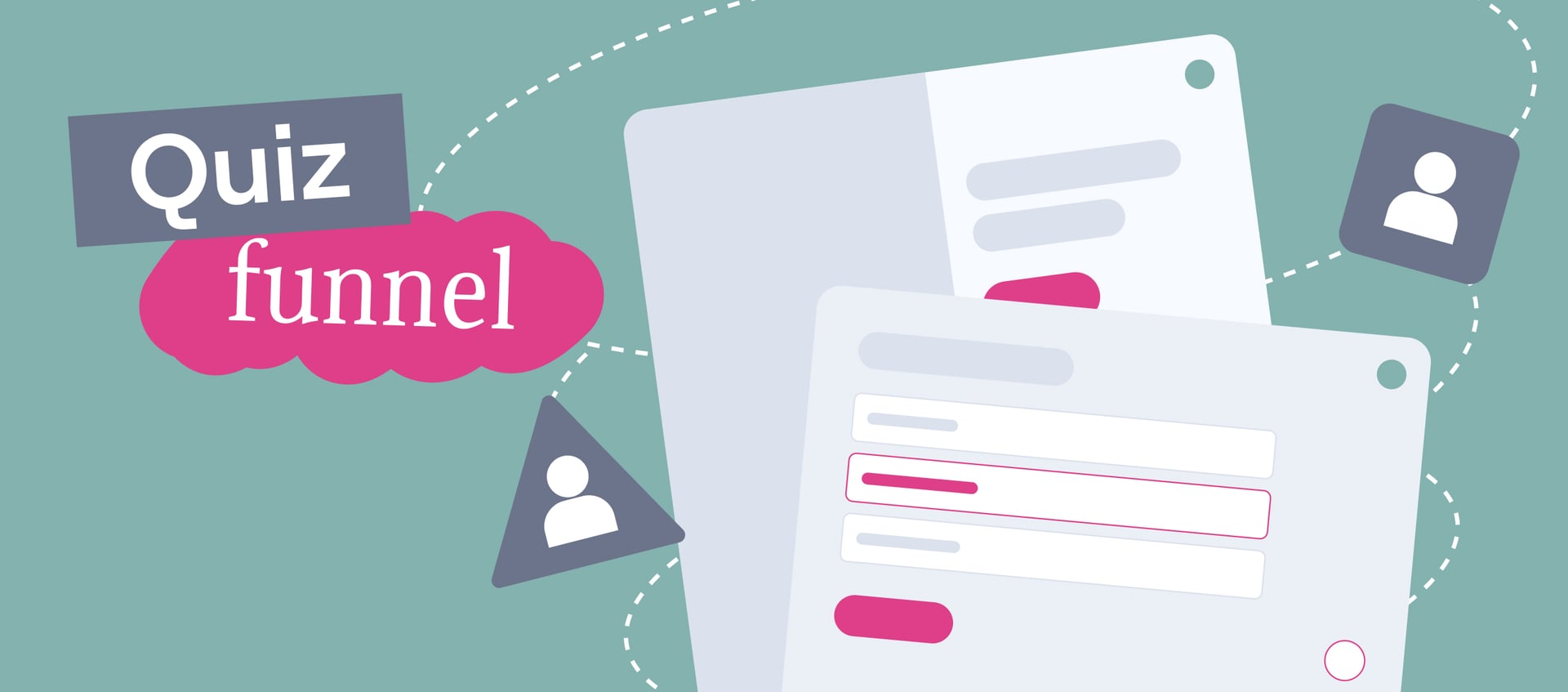
A quiz funnel is a conversion flow that replaces a traditional contact form with a guided decision process. Instead of asking for details up front, it starts with a few structured questions and uses the answers to narrow down the options.
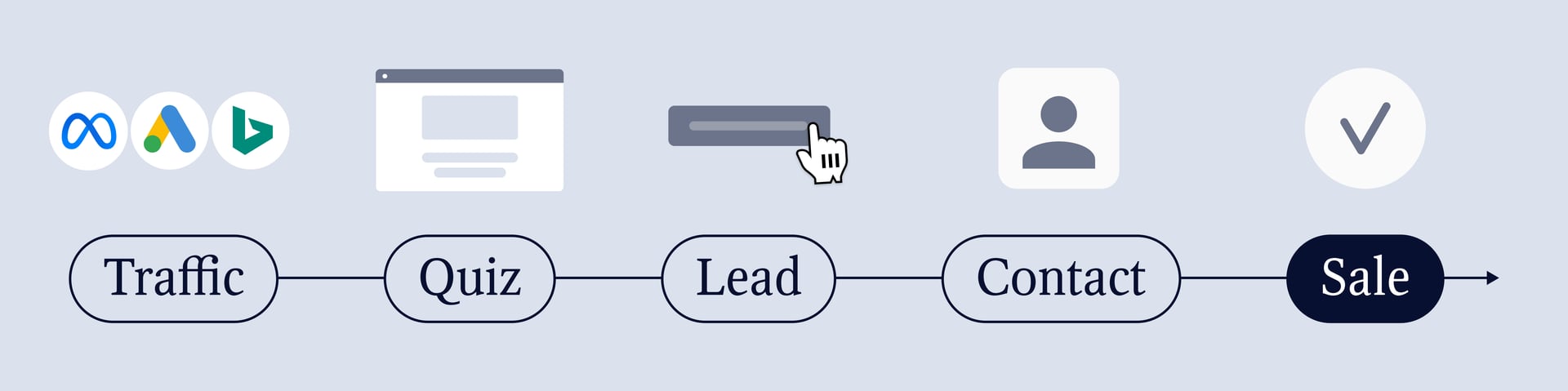
From a marketing perspective, two things happen at the same time:
- The visitor actively engages in the process instead of passively reading a page
- The business collects qualification data before the lead appears
By the end of the quiz, the recommendation (product, service, or offer) is no longer generic. It reads as the logical result of the user’s own choices. Leaving their details feels like finishing a decision they already started, rather than answering a cold request.
5 benefits of using quiz funnels
Quiz funnels are a flexible conversion tool that can generate leads from multiple traffic sources — search, social media, email campaigns, and even offline channels like QR codes or in-store promotions.
1. Capture attention without pushing a sale. A quiz opens with a simple, low-commitment step. Answering one relevant question feels easier than committing to a purchase, so even cold traffic engages longer and fewer people bounce.
2. Increase conversions through guided choice. Instead of leaving visitors to compare options on their own, the quiz narrows the choice and explains each recommendation. Browsing becomes a guided path to a decision.
3. Reduce hesitation and build confidence. A personalized result feels like genuine advice. The visitor sees a recommendation that fits their own answers, so the decision feels like theirs rather than something imposed.
4. Qualify leads before sales contact. Every answer adds context: needs, urgency, budget, preferences. A lead arrives as more than just an email. Even visitors who never finish still leave useful signals about what your audience wants and where it hesitates.
5. Ask for contacts at the right moment. The contact form appears once the visitor expects a personalized result. By then it feels like a fair exchange.
Quiz funnels are easy to integrate into an existing sales funnel or to build a new one around them — from first touchpoint to qualification and follow-up communication.
Top 15 quiz funnel examples & free templates
Below are practical quiz funnel formats you can adapt to different business models and stages of the customer journey. Each example explains what problem the quiz solves, what traffic it works best with, and how the funnel converts visitors into leads.
💡 You can use any of these 15 examples as a template to make a quiz funnel of your own. To browse all templates, visit our Template Gallery.
1. Lifestyle quiz (Tour selection)
A lifestyle quiz helps users choose an option based on preferences rather than technical parameters. It works especially well in industries where the decision depends on taste, expectations, or personal comfort — travel, education programs, hobbies, and leisure services.
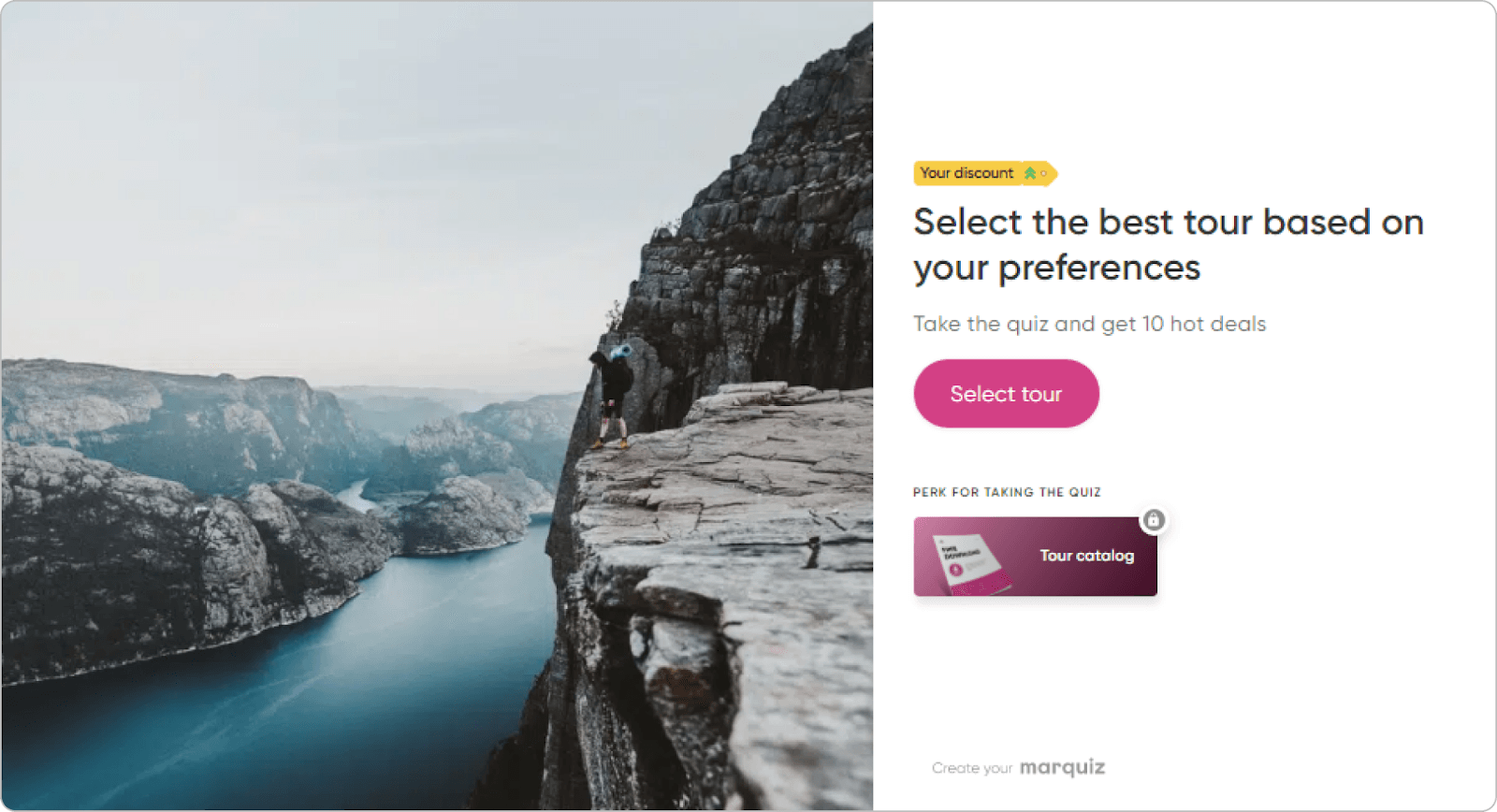
Check the tour selection quiz template to see what it looks like in a real scenario
This type of quiz is usually placed on the main landing page, in ads traffic pages, or even as a pop-up after a user browses several offers. It should appear at the moment when potential customers start comparing options and feel unsure.
In one Marquiz case, a travel agency swapped its landing page for a quiz and saw conversion climb from 0.89% to 9.23%: roughly 10x more leads from the same traffic.
Goal: Help visitors pick a tour that fits their preferences (budget, format, expectations) and turn browsing into a booking inquiry.
Best traffic source: High-intent search + warm website visitors weighing alternatives (e.g., “travel packages price”, “which tour to choose”).
Funnel structure:
- Trip type (mountains / beach / city / culture / extreme)
- Expectations (relaxed vs active, comfort level, authentic places)
- Travel format (solo / couple / family / group)
- Duration (3–21 days)
- Budget range
- Result page: recommended tour + perks + lead capture for deals/catalog
When NOT to use: If you sell one fixed package or can’t personalize the recommendation — the value comes from selection.
2. Beauty quiz (Hair routine)
Beauty quizzes are commonly used in ecommerce where customers face too many similar products and don’t understand which one fits them. Overwhelmed by the variety of options, they embrace the quiz that offers a guided product selection. A beauty quiz works best for skincare, haircare, cosmetics, supplements, and other categories where the right choice depends on personal characteristics.
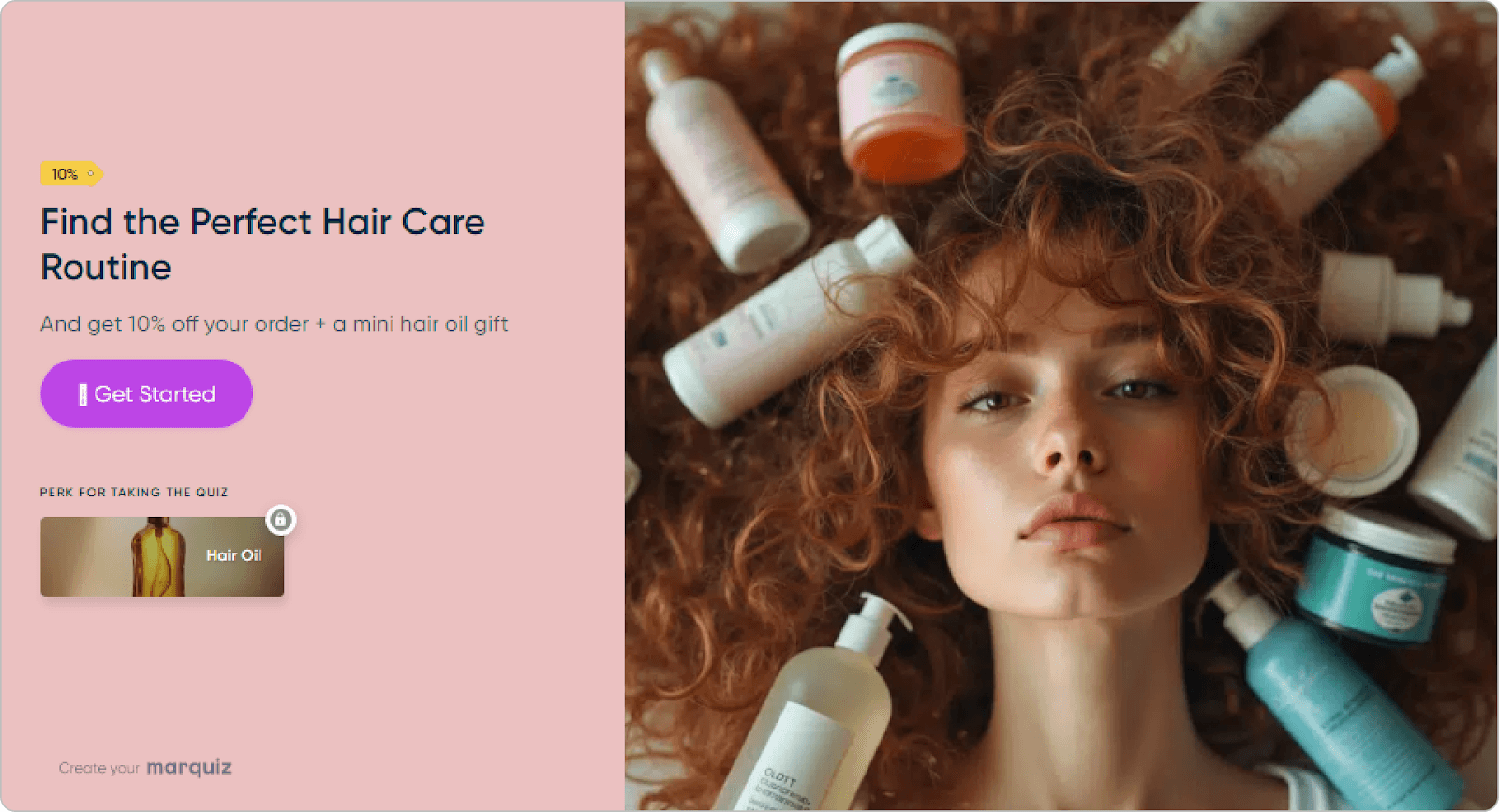
The hair care quiz template delivers a curated routine with a reward and helps customers choose products faster
Goal: Help customers choose a suitable hair routine and reduce choice overload in beauty catalogs.
Best traffic source: Search + shopping intent traffic (e.g., “hair care for damaged hair”, “routine for curly hair”) and category page visitors.
Funnel structure:
- Promise (routine + discount + sample)
- Hair type (straight / wavy / curly)
- Hair condition (dry, damaged, oily)
- Styling habits (heat tools frequency)
- Matched product set (3–6 items)
- Results page with add-to-cart
- Lead capture to unlock discount + free sample
When NOT to use: Not ideal for stores with 1–2 products or no real personalization (everyone should buy the same item).
3. Self-discovery quiz (Traveler type)
Self-discovery quizzes are built around curiosity rather than purchase intent. The visitor isn’t choosing a product yet — they just want to learn something about themselves. Because of that, the interaction feels like entertainment first and only later becomes a commercial touchpoint.
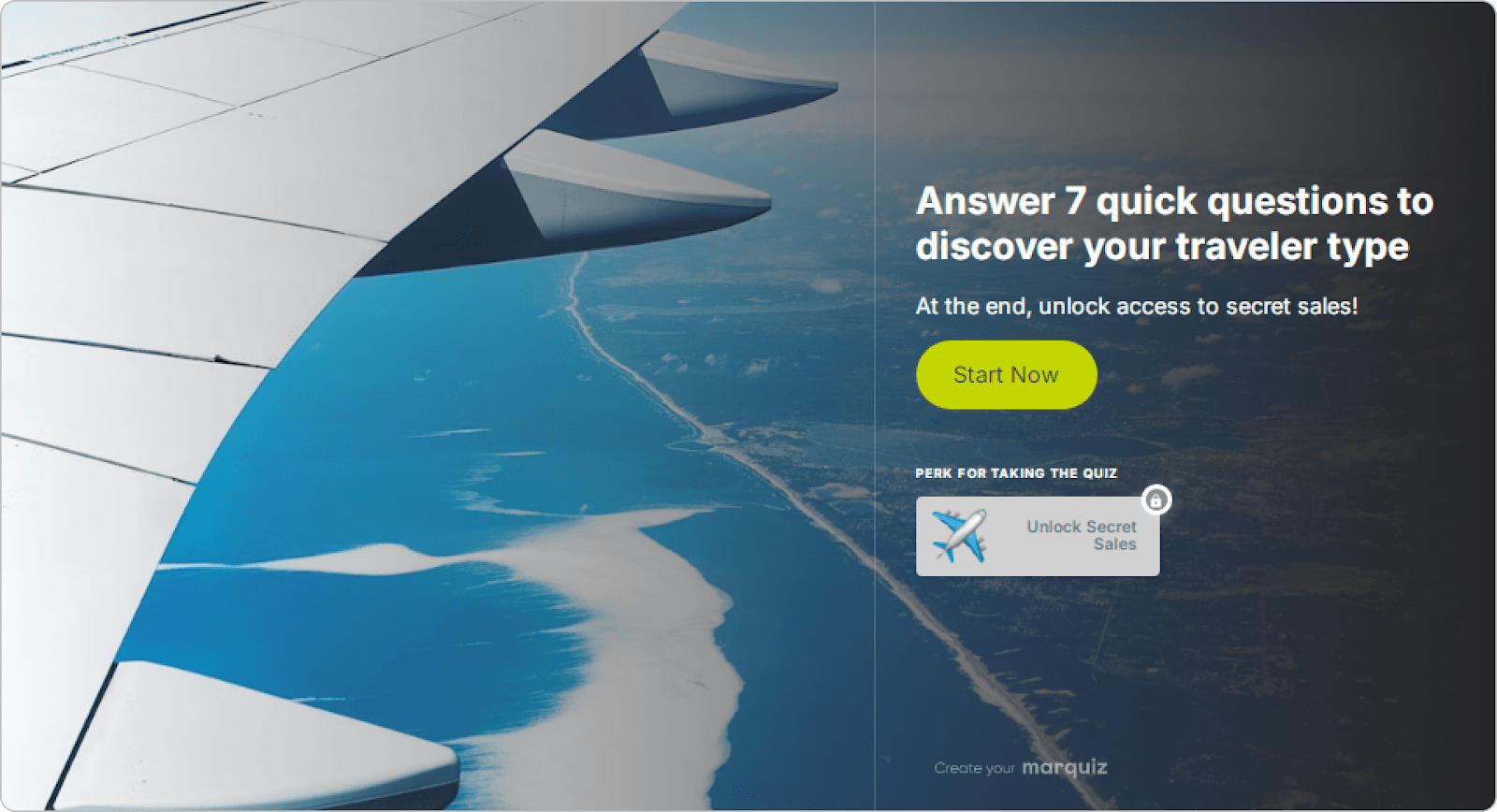
The traveler type quiz template in the Marquiz gallery captures leads by matching travel offers to the user’s lifestyle
Goal: Engage cold audiences through entertainment-first interaction, then convert into leads via a personalized “identity” result.
Best traffic source: Cold traffic: social ads, partnerships, newsletters, blog content, interest-based audiences.
Funnel structure:
- Hook: “Discover your traveler type”
- Lifestyle preference questions (comfort, luggage, flexibility, food, airport services)
- Personality-style result
- Offer reveal (deals / perks)
- Lead capture to unlock access
When NOT to use: Not suitable when users already have high intent to book right now; direct booking converts faster.
4. Product discovery quiz (Glasses selection)
This type of quiz works when the customer is already in the buying stage but hesitates at the selection step. With many similar options, people compare endlessly and postpone the purchase. The quiz simplifies the decision by translating personal preferences into a clear recommendation.

See the glasses quiz template, where product browsing is replaced with a guided consultation that improves conversions
Goal: Reduce choice overload and turn uncertainty into a confident product selection.
Best traffic source: Warm and high-intent traffic: search (”best frames for round face”), product page visitors, retargeting of non-buyers.
Funnel structure:
- Hook: “Find frames that fit your face”
- Qualification questions (face shape, style, comfort, habits)
- Personalized shortlist (3–6 products)
- Explanation: why these options fit
- Lead capture to save results / unlock bonus (discount, free eye exam)
When NOT to use: If you have a tiny catalog or no meaningful differences between items. A quiz may add friction.
5. Consultation quiz (Service matching)
A consultation quiz is useful when a visitor feels a problem but doesn’t understand which service or specialist they actually need. Because of that uncertainty, people often postpone booking. The quiz replaces the first conversation and helps them describe their situation step-by-step before committing to a call.

A good example is the mental health support quiz template, which performs a quick triage before suggesting the next step
Goal: Diagnose what the user actually needs and convert uncertainty into a booked consultation.
Best traffic source: High-consideration traffic: “how to choose a therapist”, educational readers, retargeting visitors who explored services but didn’t book.
Funnel structure:
- Soft entry question (”What are you looking for help with?”)
- Clarifying questions (issue type, urgency, preferences)
- Qualification (format, budget, availability)
- Match (specialist/service recommendation)
- Booking step + incentive
When NOT to use: For simple transactional services (e.g., standard cleaning) where intent is already clear. In this case, direct booking wins.
6. Diagnostic quiz (Career self-assessment)
A diagnostic quiz works when the visitor is actively trying to understand their situation, not just browse options. Instead of immediately contacting a company, the person first evaluates their own condition, and the result naturally leads to a consultation or program as the next step.
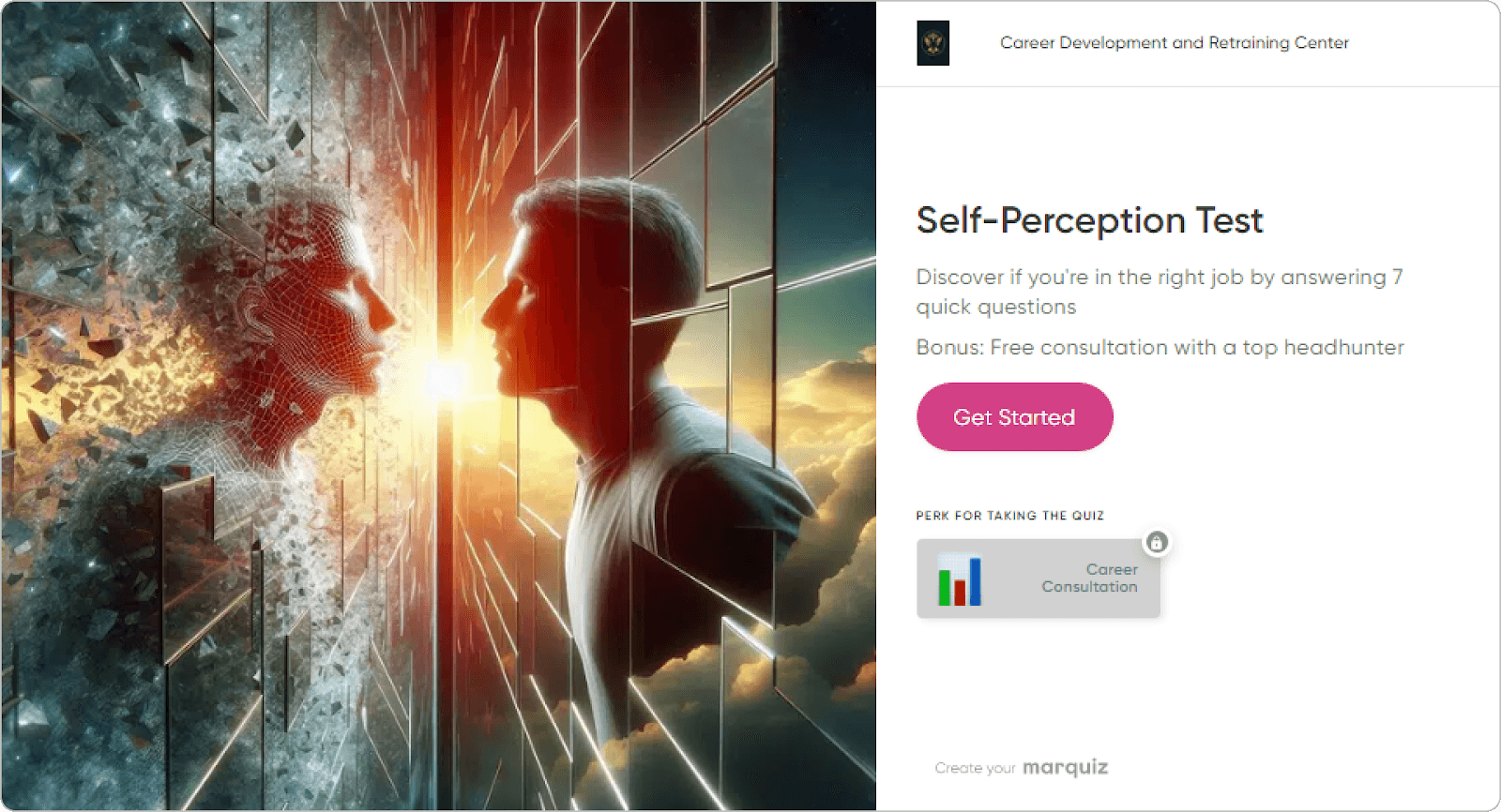
Marquiz’s self-perception test template guides users to the natural next step after a short diagnosis
In one Marquiz case, an online HR-course provider ran a career-assessment quiz across India and the US, emailing each participant a personalized development plan. It brought in over 700 leads in three months at nearly a 36% conversion rate.
Goal: Replace the first discovery call with structured self-assessment and pre-qualify leads.
Best traffic source: High-intent SEO + search ads (e.g., “should I change careers”), plus retargeting of interested visitors.
Funnel structure:
- Problem hook (”Are you in the right job?”)
- Diagnostic questions (satisfaction, growth, environment, confidence)
- Interpreted result (not just a score)
- Recommended next step (consultation / program)
- Lead capture to unlock detailed advice
When NOT to use: For low-consideration purchases or simple offers that don’t require interpretation.
7. Product recommendation quiz (Humidifier selection)
Some categories are difficult not because the product is expensive, but because it’s technical. Buyers don’t understand which parameters actually matter, so they compare specifications, read reviews, and delay the purchase. A recommendation quiz converts technical complexity into simple choices and guides the user to a suitable model.
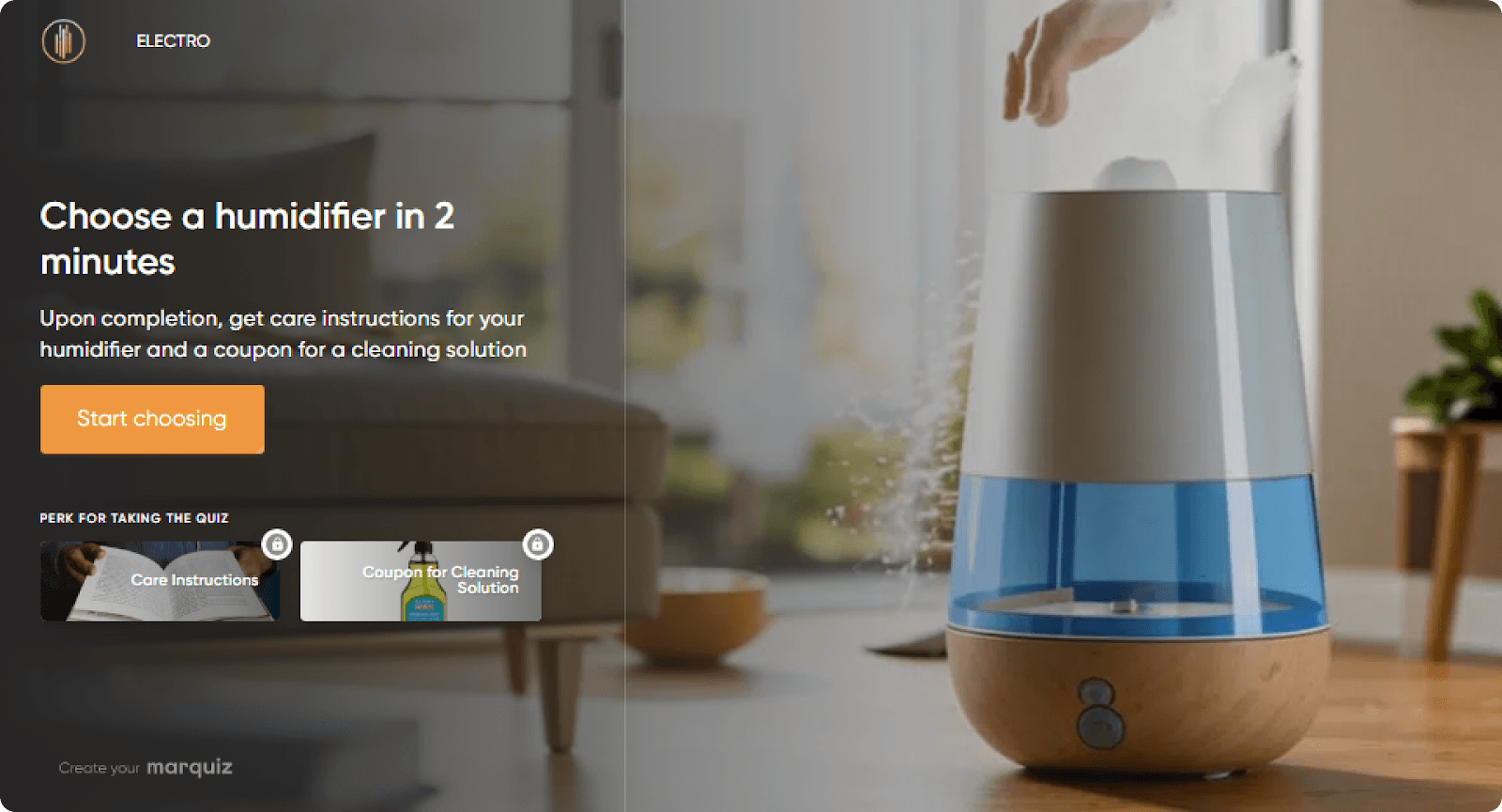
The humidifier selection quiz template helps customers navigate technical parameters and make the purchase decision faster
Goal: Turn a confused researcher into a confident buyer by translating needs into product specs.
Best traffic source: Warm intent traffic: “which humidifier to choose”, category visitors, comparison-page readers.
Funnel structure:
- Hook: “Choose a humidifier in 2 minutes”
- Practical questions (room size, usage, features)
- Micro-education inside the flow (types, maintenance)
- Personalized recommendation page
- Lead capture or direct purchase CTA
When NOT to use: Impulse purchases or obvious choices where a quiz adds unnecessary steps.
8. Problem-solving quiz (SPF / tanning)
Sometimes the visitor isn’t choosing between products yet — they are trying to understand a situation. Articles explain in general terms, product pages sell, but neither answers the personal question: what does this mean for me? A problem-solving quiz works in the middle: it interprets the situation first and introduces the product as the solution.
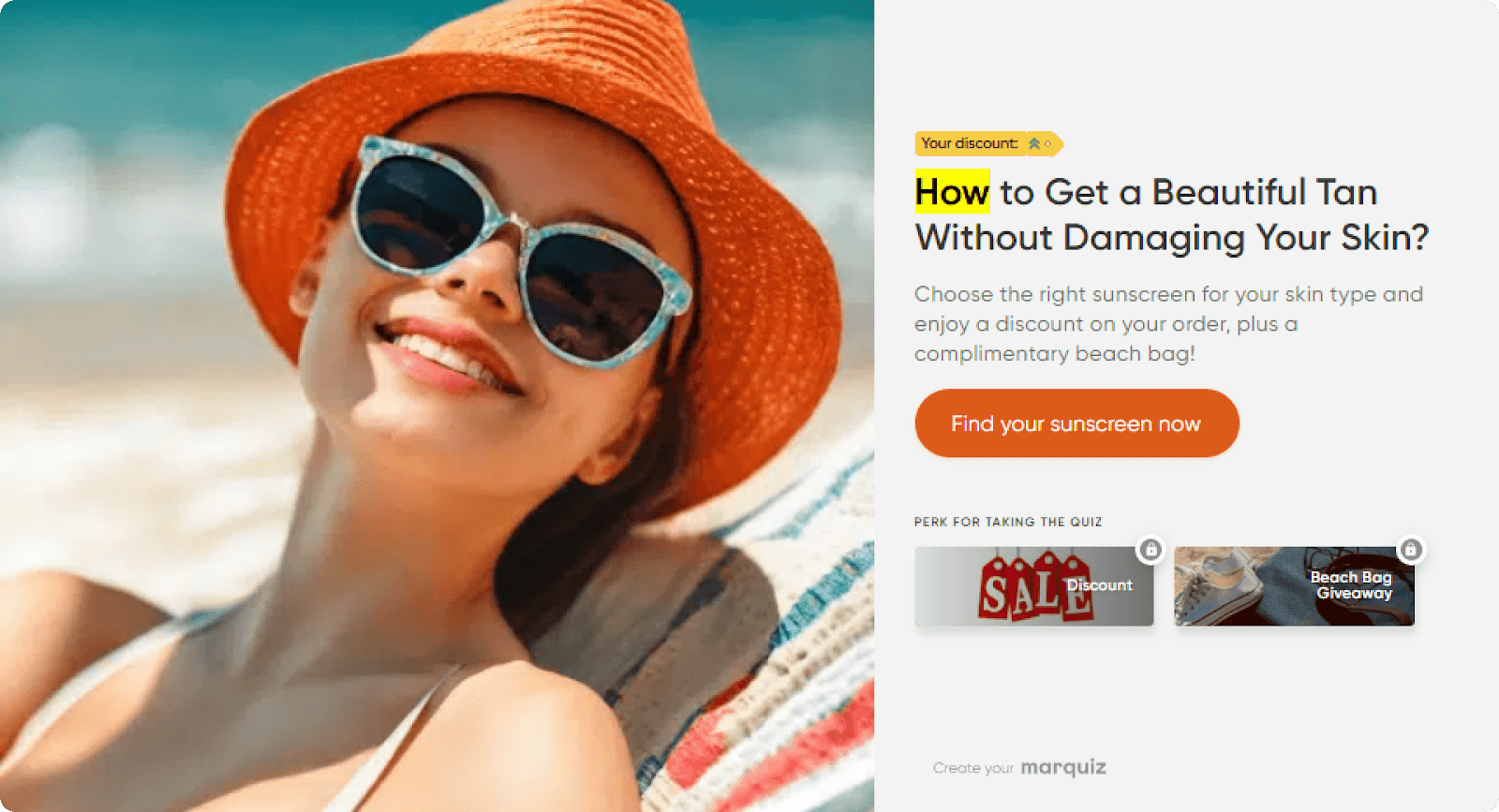
In the tan safely quiz template, educational guidance naturally leads to the product as the next step
Goal: Educate first, then sell — turn informational intent into a solution-based purchase.
Best traffic source: Informational intent traffic: “which SPF do I need”, blog content, social education posts.
Funnel structure:
- Hook: “How to tan safely?”
- Context questions (exposure, sensitivity, habits)
- Explanation (why protection level matters)
- Personalized solution (SPF + product)
- Offer (discount / bonus)
When NOT to use: When customers already know exactly what they want and don’t need education.
9. Gated offer quiz (Reward unlock)
This format relies on a simple behavior pattern: people hesitate to share contacts, but they hesitate even more to lose something they’ve already earned. The quiz is intentionally quick, and the value is concentrated at the very end — exactly where the contact step appears.
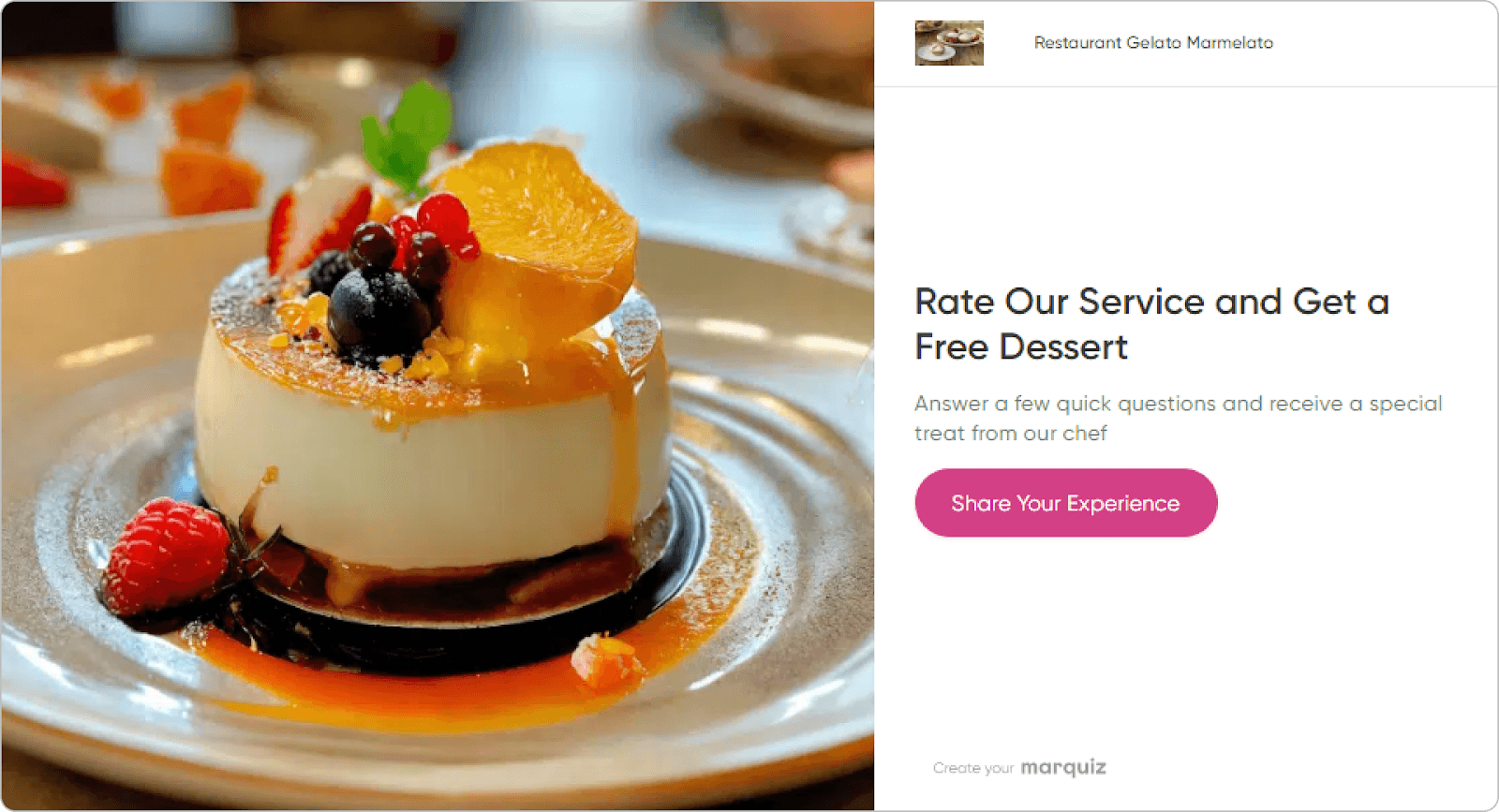
The rate our service quiz template brings more leads because few people would miss a free dessert
Goal: Collect contacts by locking an immediate reward behind completion.
Best traffic source: Offline / post-purchase traffic: QR codes on receipts, packaging, table tents, delivery inserts.
Funnel structure:
- Promise (”Rate your visit and get a free dessert”)
- Very easy questions (ratings)
- Reward expectation
- Lead capture to unlock reward
- Follow-up marketing (SMS/email)
When NOT to use: Cold traffic with no relationship to the brand. Without trust, gating can feel like friction.
10. Awareness quiz (Self-assessment)
This type of quiz is used earlier in the decision process. The user is not looking to buy yet — they are trying to understand whether there is a problem at all. Instead of promoting a service, the funnel first helps the person evaluate their situation.

The awareness quiz template feels like guidance rather than marketing and helps you build trust with users
Goal: Create awareness and emotional involvement, then convert concern into a consultation lead.
Best traffic source: Warm informational traffic: SEO queries, blog readers, educational content.
Funnel structure:
- Concern hook
- Behavioral questions
- Personalized assessment result
- Expert explanation
- Lead capture for resources/help
When NOT to use: Fast transactional products where the decision is immediate and not emotional.
11. Cost calculator quiz (Price estimate)
Cost calculator quizzes address one of the biggest conversion blockers — unclear pricing. When a service depends on configuration, size, or options, visitors hesitate to submit a request because they don’t even know the approximate budget. The quiz replaces a sales conversation with a guided configuration.
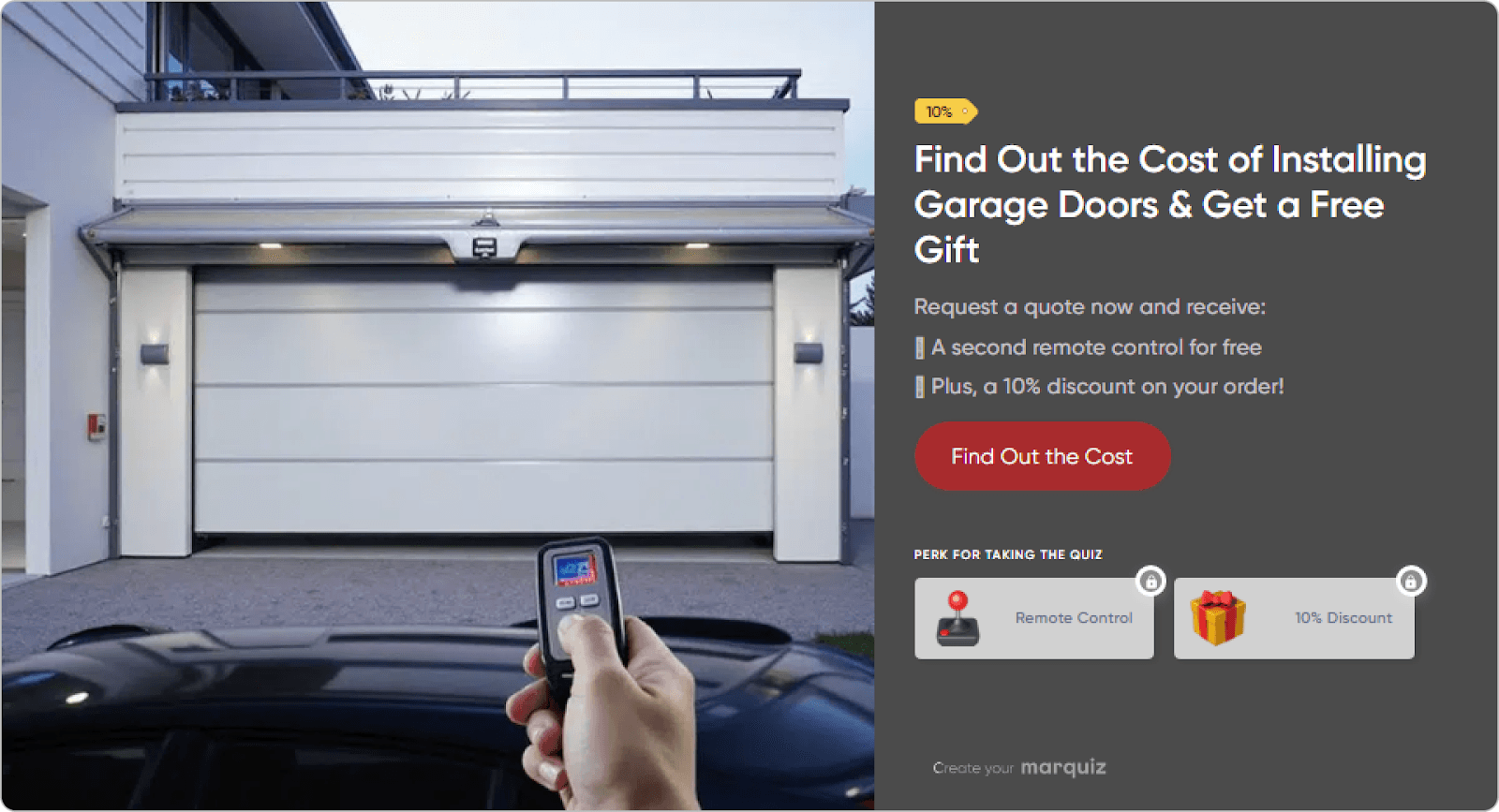
The cost calculator quiz template gives users a price estimate first, making contact the natural next step
In one Marquiz case, a soundproofing company’s cost-estimate quiz converted 25% of visitors into leads, because people got a price instead of a blank contact form.
Goal: Remove price uncertainty and convert high-intent visitors into qualified leads.
Best traffic source: High-intent search (e.g., “installation cost”, “price of X”).
Funnel structure:
- Promise (”Calculate your cost”)
- Specification questions (dimensions, options, features)
- Instant estimate
- Bonus/incentive
- Lead capture for full quote / visit scheduling
When NOT to use: Simple fixed-price products need direct pricing and fast checkout.
12. Engagement quiz (Entertainment-first lead gen)
Engagement quizzes are built around curiosity rather than purchase intent. The user enters the funnel not to solve a problem, but to interact with content — similar to a game or personality test. Entertainment mechanics lift completion rates and sharing, feeding top-of-funnel audiences for later nurturing.

The engagement quiz template based on the iconic trilogy offers three months of free streaming as a bonus
Goal: Generate low-cost leads and sharing by using game-like interaction (not sales).
Best traffic source: Cold social traffic: Instagram/TikTok/Facebook, influencers, communities.
Funnel structure:
- Curiosity hook (”Which character are you?”)
- Story-based questions
- Result reveal
- Reward unlock
- Lead capture
When NOT to use: Direct sales funnels. These leads are usually not purchase-ready.
13. Lead generation quiz (Meal plan)
Lead generation quizzes act as a lightweight consultation before the contact form appears. Instead of immediately asking for email or phone, the business first learns about the visitor’s goals and situation, so the request for contacts feels justified.
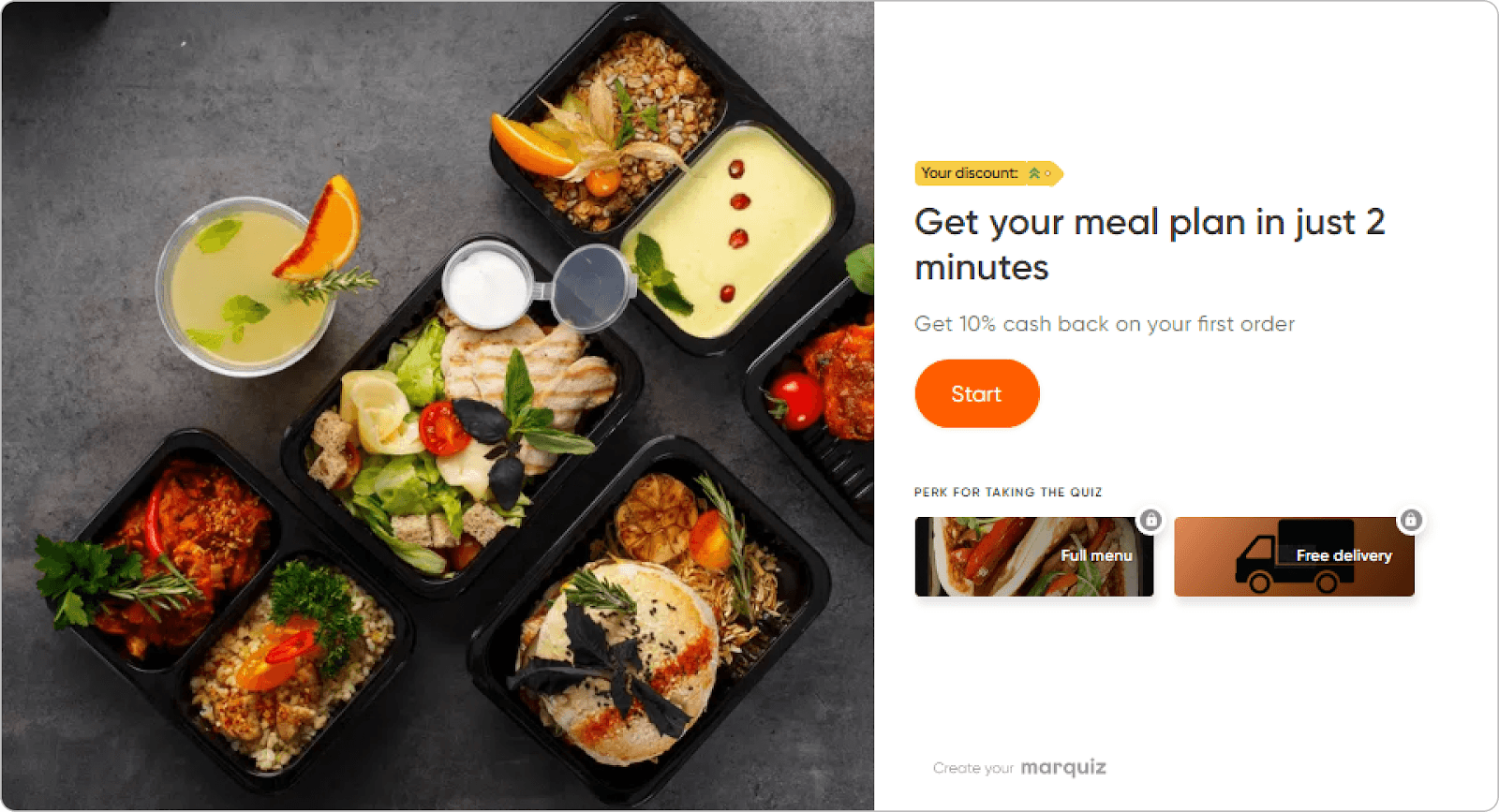
The meal plan lead generation quiz template shows the contact form only when users are ready to get their personalized plan
Goal: Turn anonymous visitors into qualified leads by personalizing the offer before asking for contacts.
Best traffic source: Cold and warm paid traffic: social ads, landing pages, new visitors with curiosity but no readiness for sales.
Funnel structure:
- Hook: “Get your meal plan in 2 minutes”
- Qualification questions (goals, schedule, preferences)
- Progress investment
- Result expectation
- Lead capture to unlock plan + bonuses
When NOT to use: If you don’t use the collected data (no personalization, no segmentation) — then it’s just a longer form.
14. Instant gratification quiz (Sushi set + coupon)
This type of quiz is used when visitors like the offer but don’t feel urgency to act. Instead of pushing them to order immediately, the funnel involves them in a small interactive step — choosing or assembling something for themselves — and reinforces motivation with an instant reward.
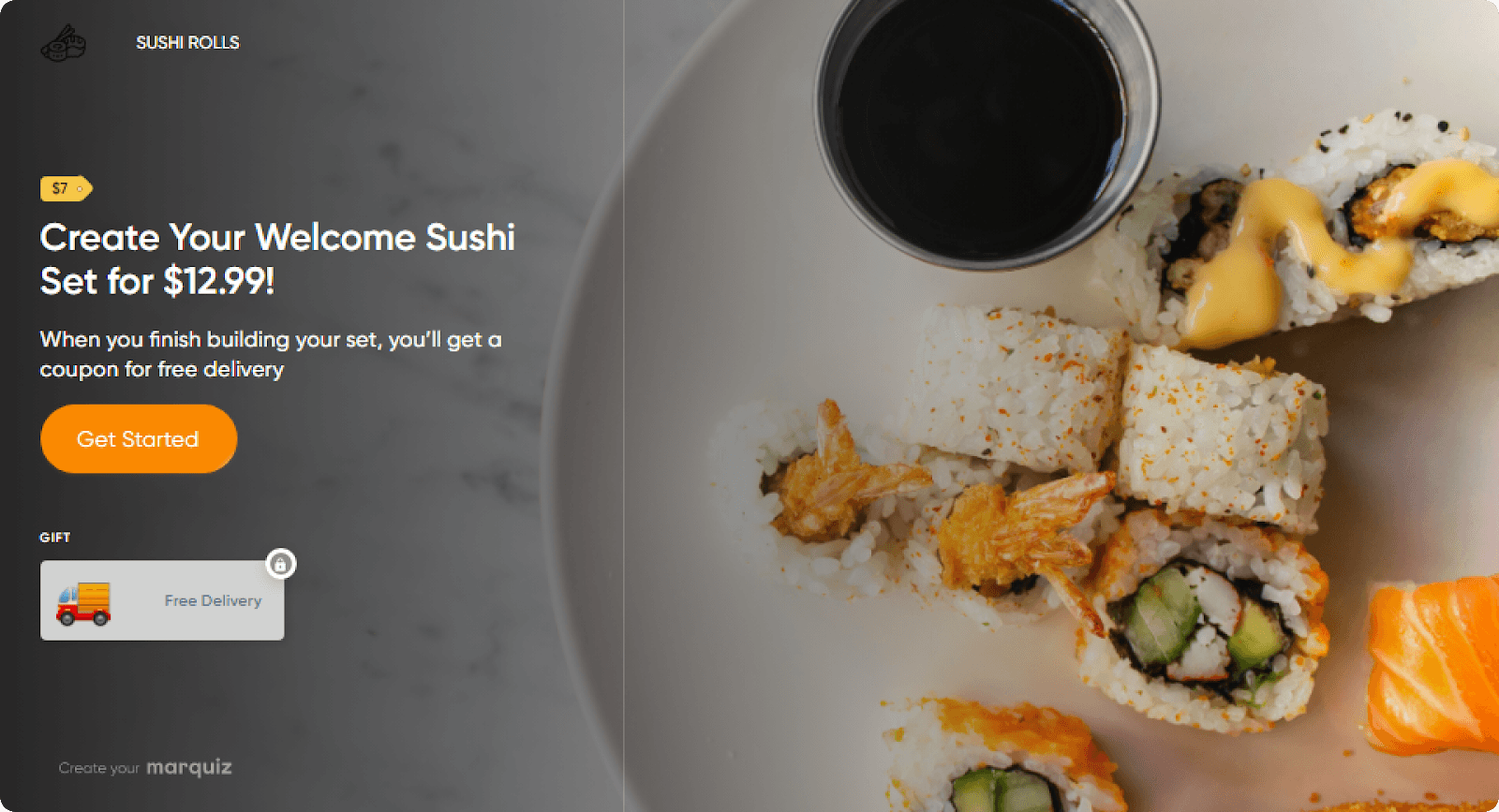
The instant gratification quiz template helps users “build” their order, so that they wouldn’t want to lose the reward
Goal: Create a small commitment before purchase and trigger immediate action with an instant reward.
Best traffic source: Cold social and local traffic: Instagram/TikTok ads, local campaigns, new visitors not planning to order yet.
Funnel structure:
- Hook: “Build your welcome sushi set”
- Interactive selection (items, extras, portions)
- Progress investment
- Reward unlocked immediately (free delivery coupon)
- Purchase step
When NOT to use: High-intent buyers who would purchase instantly anyway. A quiz might slow them down.
15. Motivational quiz (Dental: move from hesitation to booking)
Motivational quizzes are designed for situations where the main barrier is not price or choice, but postponement. People recognize a potential problem yet keep delaying action because it feels uncomfortable or unnecessary right now. The quiz offers a low-pressure first step and replaces commitment with reassurance.
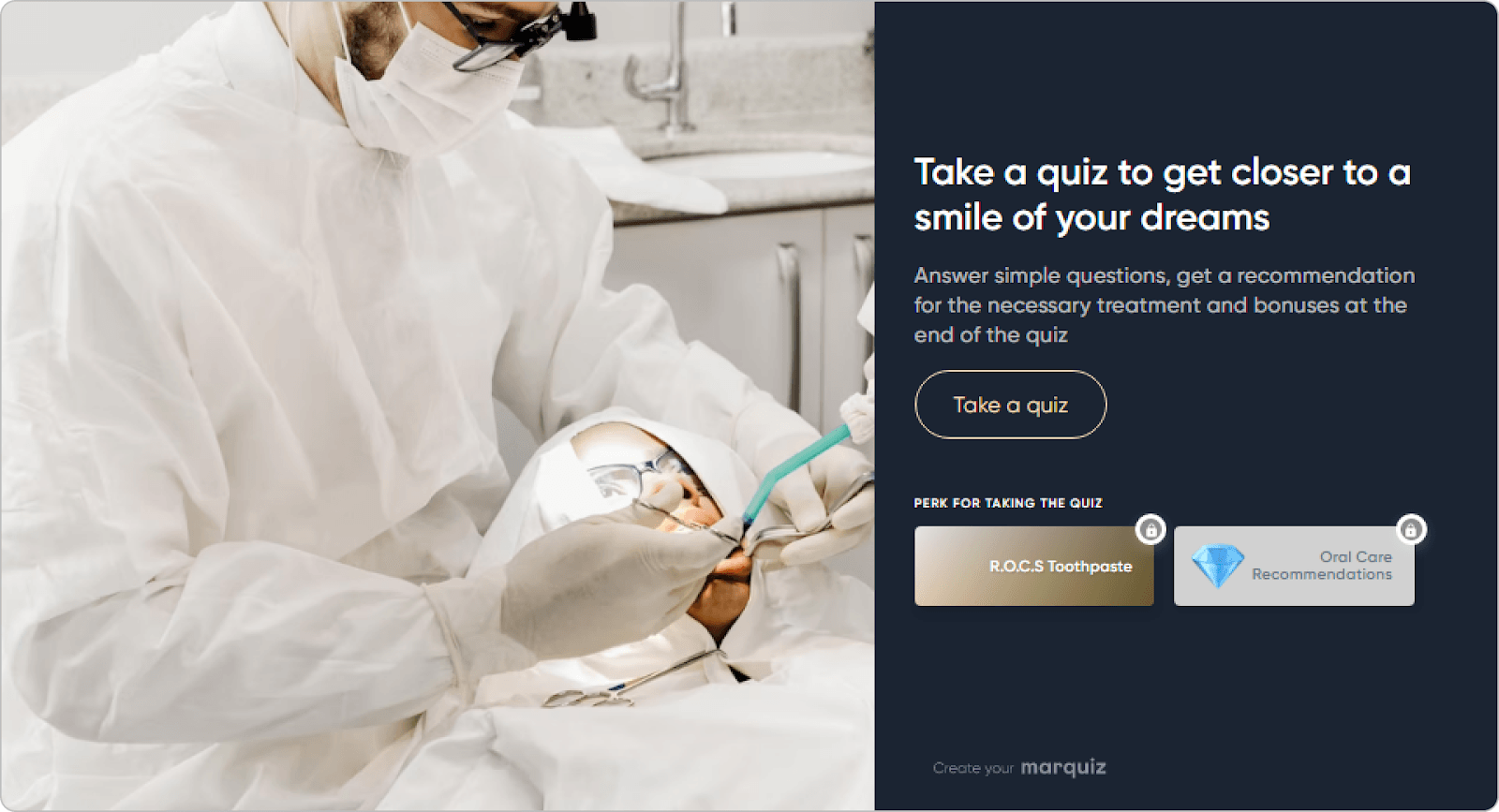
The dental motivational quiz template makes booking feel like the natural next step after reassurance
Goal: Reduce hesitation and convert “I should do it someday” into an appointment decision.
Best traffic source: Problem-aware and consideration-stage traffic — educational searches (”why gums bleed”, “is tooth pain dangerous”), social ads about symptoms, local campaigns, and visitors delaying treatment.
Funnel structure:
- Hook: “Get closer to the smile you’ve always wanted”
- Soft diagnostic questions (symptoms, last check-up, concern areas)
- Optional inputs (attach X-rays, indicate location of discomfort)
- Personalized recommendation explaining what’s happening
- Booking step + bonus for completing the quiz
When NOT to use: Pure high-intent traffic (”dentist appointment near me”). A direct booking CTA will convert faster.
How to choose the right quiz funnel for your business
The effectiveness of a quiz funnel depends on how customers usually make decisions in your industry. In some businesses people compare options, in others they first need to understand their problem, and in many services they simply postpone action. A quiz works best when its logic mirrors that real-world decision process.
The table below summarizes which template fits which business model, what type of leads it typically generates, and how complex it is to implement. In further sections, we examine three niches in detail and add a short performance snapshot wherever we have real campaign data.
| Template | Best For | Funnel Stage | Lead Quality | Setup Time | Automation Level |
| Buyer Qualification Quiz | Real Estate | Mid | High | Medium | High |
| Product Recommender | eCommerce | Mid | Medium | Medium | High |
| Marketing Audit Quiz | B2B | Top–Mid | Very High | High | High |
| Career Fit Diagnostic Quiz | Education / Coaching | Top | Medium | Low | Medium |
| Cost Calculator Quiz | Home Services | Mid–Bottom | High | Medium | High |
| Instant Gratification Quiz | Food Delivery / Local | Top–Mid | Medium | Low | Medium |
| Motivational Readiness Quiz | Health / Clinics | Top–Mid | High | Medium | Medium |
💡 Read our article on what the best quiz funnel software tools are.
For B2B
B2B deals rarely close on a first form. The decision involves budget, several stakeholders, and a real evaluation, so the first job of a quiz here is to qualify: to sort serious prospects from browsers before sales ever picks up the phone. These three formats do exactly that.
1. Diagnostic quizzes qualify leads by needs, scale, and urgency, then end with a recommended solution and a clear next step. Example: an accounting firm asks about company size, number of employees, and reporting obligations to determine whether the business needs bookkeeping, payroll support, or tax consulting.
👉 What it changes in the funnel: fewer bad-fit leads and easier sales conversations because the client arrives with context.
In one SaaS implementation, three quiz funnels generated 1,022 leads and 76 closed deals over 12 months. The most detailed diagnostic quiz produced fewer submissions than a simplified form, but converted into sales significantly better — showing the main purpose of B2B quizzes is qualification, not maximum lead volume.
2. ROI calculators help clients justify the expense before contacting sales, ending on a cost-versus-benefit estimate and a clear call to action. Example: a commercial cleaning company calculates monthly cleaning cost based on office size and visit frequency, then offers a contract proposal.
👉 What it changes in the funnel: reduces “price-checking” inquiries and shifts the first conversation from “how much?” to “when can we start?”
3. Audit funnels replace “request a quote” with a structured assessment that surfaces the issues, lays out an action plan, and ends with a booking. Example: an IT support provider runs a “Check your office IT security” quiz and offers a system inspection visit.
👉 What it changes in the funnel: the lead becomes pre-qualified before talking to sales, and the company already knows the technical situation and urgency.
For eCommerce
Online stores usually lose the sale at the moment of choice, when there are too many similar products and too little guidance. A quiz turns aimless browsing into a short, guided selection and hands the shopper a shortlist they can act on.
1. Product match quizzes narrow a large assortment to a small curated set. Example: a mattress store asks about sleep position, weight, and firmness preference and recommends 2–3 suitable models.
2. Style / preference quizzes are useful where comfort or appearance matters. Example: an optical store helps users choose eyeglass frames based on face shape and daily usage (office work, driving, sports).
3. Product discovery quizzes help when customers want to buy but are overwhelmed by choice. Example: a paint store asks about room type, lighting, and wall condition and suggests the correct paint type and quantity.
👉 What it changes in the funnel: guided choice reduces decision friction and increases completion of the inquiry or purchase step.
In an education service campaign (a similar “complex choice” scenario), a quiz-based landing converted 5.58% of visitors into leads versus 2.65% on a traditional website page, because users received a recommendation instead of reading long explanations.
For Services
Service quizzes serve different goals. Some help a hesitant client finally decide to act, while others filter out the wrong-fit enquiries before they take up your team’s time.
1. Readiness quizzes reduce hesitation and help the person decide whether they should act now. Example: a dental clinic asks about bleeding gums, sensitivity, and last visit to determine whether the user needs urgent treatment or preventive cleaning.
👉 What it changes in the funnel: gives the person a concrete reason to act instead of postponing and thus converts “maybe later” into a booking now.
2. Qualification quizzes filter serious clients and prepare a quote. Example: a home renovation company asks about property size, type of renovation, and budget to prepare an approximate project estimate.
👉 What it changes in the funnel: you collect fewer but better-fit enquiries, each already carrying the scope and budget needed to prepare a quote.
3. Consultation quizzes help people who don’t know which specialist they need. Example: a car repair service asks about symptoms (noise, vibration, warning lights) and routes the customer to diagnostics, engine repair, or suspension service with an appointment booking.
👉 What it changes in the funnel: there’s no triage step and the first conversation is already on topic.
Quiz funnel optimization checklist
This checklist focuses on where quiz funnels actually lose users — not on UI details, but on behavior.
✔ Promise a concrete outcome on the start screen. “Calculate your renovation cost in 2 minutes” starts far more people than a vague “Take our quiz.”
✔ Make the first question effortless. Its job is to get people moving, so save budget, phone, and technical questions for later.
✔ Keep the flow logical. Each question should follow from the last; a stray “How did you hear about us?” mid-quiz breaks the sense of guidance.
✔ Show progress. People abandon uncertain quizzes, not long ones, so a progress bar with the end in sight keeps them going.
✔ Explain the result. Don’t just show a product, say why it fits their answers; that’s what makes the contact step feel logical.
✔ Ask for contacts at the value moment. The form should appear exactly when the visitor expects the result or bonus, once they’ve already invested effort.
✔ Make follow-up part of the funnel. Email, SMS, or retargeting should continue the conversation using the collected answers.
In practice, quiz funnels outperform forms not because they are interactive, but because they guide a decision. Every element above supports that decision process instead of interrupting it.
FAQ
How many questions should a quiz funnel have?
Most quiz funnels work best with 4 to 7 questions before the contact form. A basic lead generation quiz usually needs 4–6: enough to give a personal result without tiring the visitor. For cold traffic from social ads, stay closer to 4. Cost calculators and diagnostic quizzes can go up to 7, and sometimes beyond, because the visitor expects a detailed result in return. Whatever the number, keep a question only if it changes the recommendation or tells your sales team something useful about the lead. After launch, check where people drop off and rewrite or remove the question that loses the most users.
When is a regular contact form better than a quiz funnel?
When the visitor already knows exactly what they want. Someone searching for “dentist appointment near me” or ordering a fixed-price product doesn’t need guidance, and extra questions only slow them down. A quiz pays off when people hit a real barrier before contacting you: too many similar options, an unclear price, or doubt about whether they need your service at all. That’s why each example above has a “When NOT to use” note.
Can I build a quiz funnel for free?
Yes. Marquiz has a free plan that includes 10 leads a month and has no time limit. That’s enough to launch a template on real traffic, see how people move through it, and fix weak spots before you put money into ads.
How do I know if my quiz funnel is working?
Look at the funnel step by step, not just at the total number of leads. The start rate shows whether the promise on your start screen is clear. Completion rate and drop-off per question show where the flow loses people. Then compare how many quiz leads turn into sales with the results of your old form. A detailed quiz can bring fewer submissions but more closed deals, as in the B2B example above.
Key takeaways
A quiz funnel converts better than a form because it guides a decision instead of demanding one.
Three things make or break a funnel: a clear promise on the start screen, an easy first question, and a result page that explains the recommendation.
Match the format to how your customers decide. The barrier they hit most often (too many options, unclear price, postponing, etc.) points to the right quiz type.
Test before you spend. The free plan lets you validate the flow on real traffic before spending anything on ads. Launch a template, watch how people move through it, and let the drop-off points tell you what to fix next.