
How EdTech School Kodland Generated 1M+ Leads with Quizzes Across 12 Countries
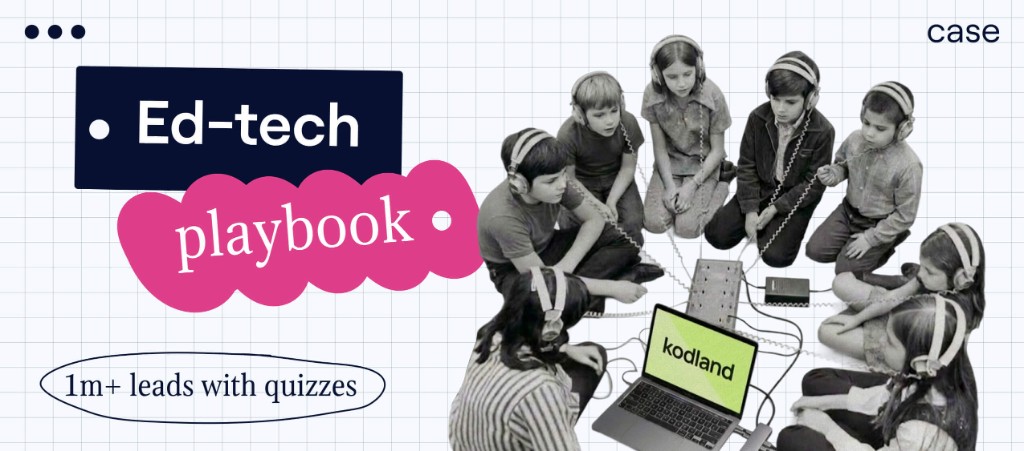
Kodland is an international online school teaching kids aged 8–17 programming, web development, design, and math. Students start with Roblox and Minecraft and work their way up to building their own games, websites, and projects. Marketing drives traffic to a free trial lesson in more than a dozen countries. The team has been using Marquiz since April 2020.
| Metric | Results with Marquiz quizzes |
| Leads | 1M+ since April 2020 |
| Geography | 12 countries — localized funnels for each market |
| Funnels | Hundreds of quizzes for different segments, offers, and creatives |
A playbook that works across markets
Every new market used to follow the same slow cycle: build a landing page, wait for launch, spend on traffic, and only then find out if the hypothesis worked.
Instead of betting on a landing page, the Kodland team uses quizzes to quickly test demand, offers, and the ad-to-conversion flow.
Over the years, that turned into a working system: hundreds of quizzes, scenarios adapted to each market and segment, and a steady stream of leads across geos and offers.
Hitting the right message in each market isn’t luck — it’s deliberate work
The quiz helped marketers test different tactics and find what converts in each market.
Tactic №1. Segment by who’s taking the quiz
In kids’ EdTech, the person who starts a lead isn’t always the decision-maker. A child sees the ad, clicks, takes the quiz — but the parent is the one who buys.
Kodland accounts for this in the first questions: the quiz asks who’s answering — parent or child.
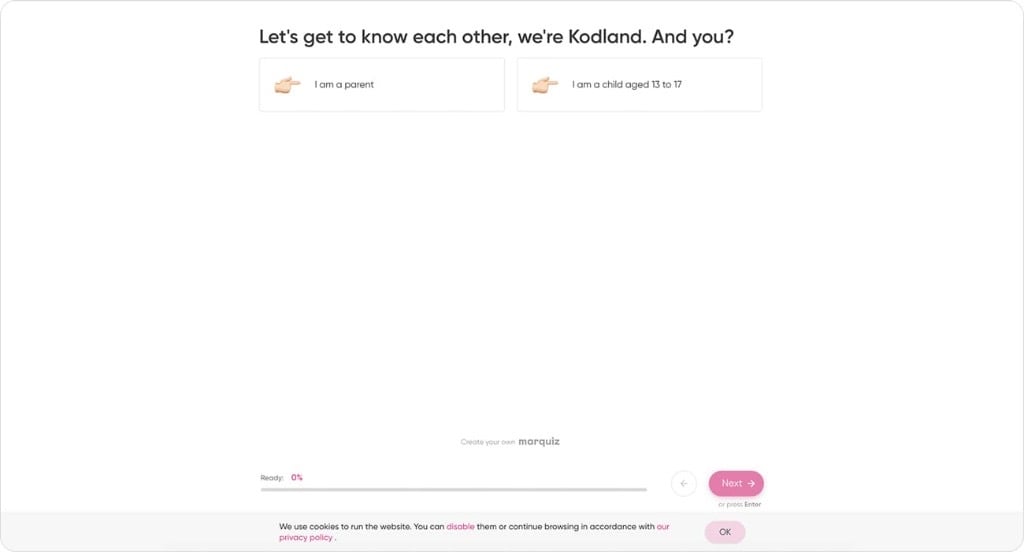
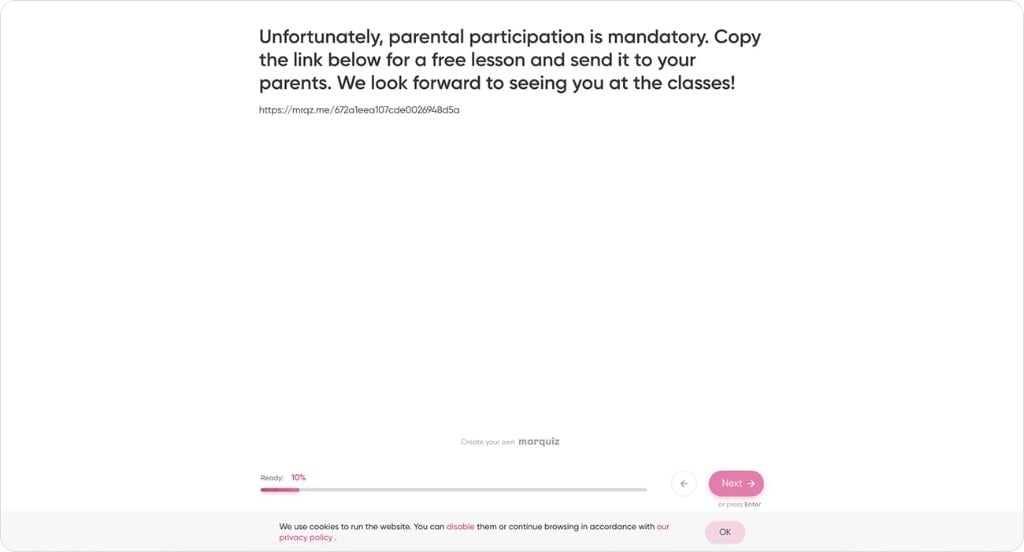
If a teenager shows up, the quiz shows a screen: a parent must attend the lesson, copy the link, and send it to them. The teen forwards a short link in a messenger app, and the parent continues the quiz — with a different set of questions and actual purchasing power. That filters out leads without a payer and tells the team who’s on the other side of every signup.
Tactic №2. Use familiar visuals instead of generic copy
Kodland skips the vague “learning for kids” or “programming” pitch and packages the product through clear entry points: Minecraft, Roblox, drawing on a tablet, personal projects, cybersecurity.
At the ad and quiz start page level, users see a scenario that’s easy to step into. For a child, it sounds like something fun to do. For a parent, it sounds like real value: the kid isn’t just playing games or scrolling on a tablet — they’re learning through a format they already know.
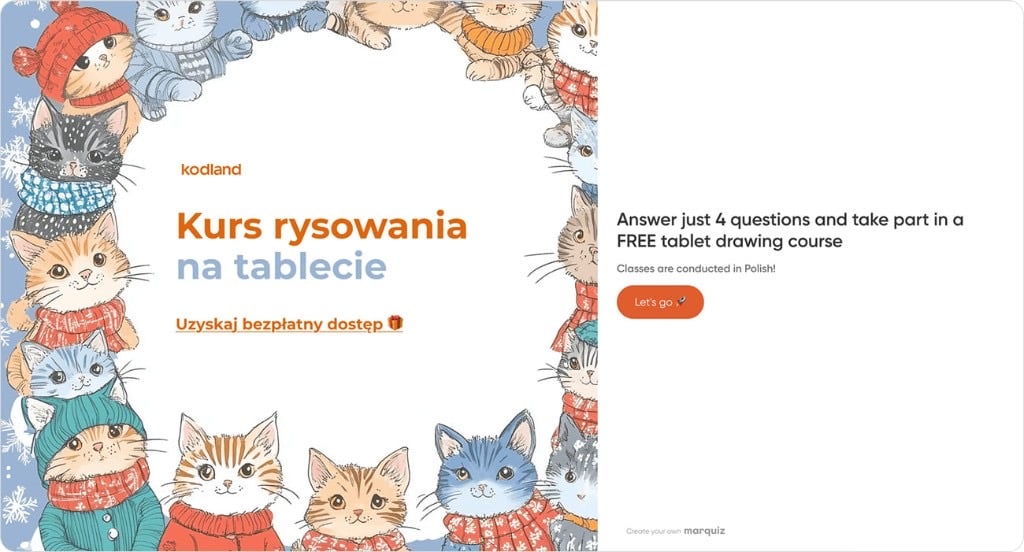
1. Instead of a “drawing course” — “drawing on a tablet.” For a child, that sounds modern and visual. For a parent, it’s a clear digital skill.
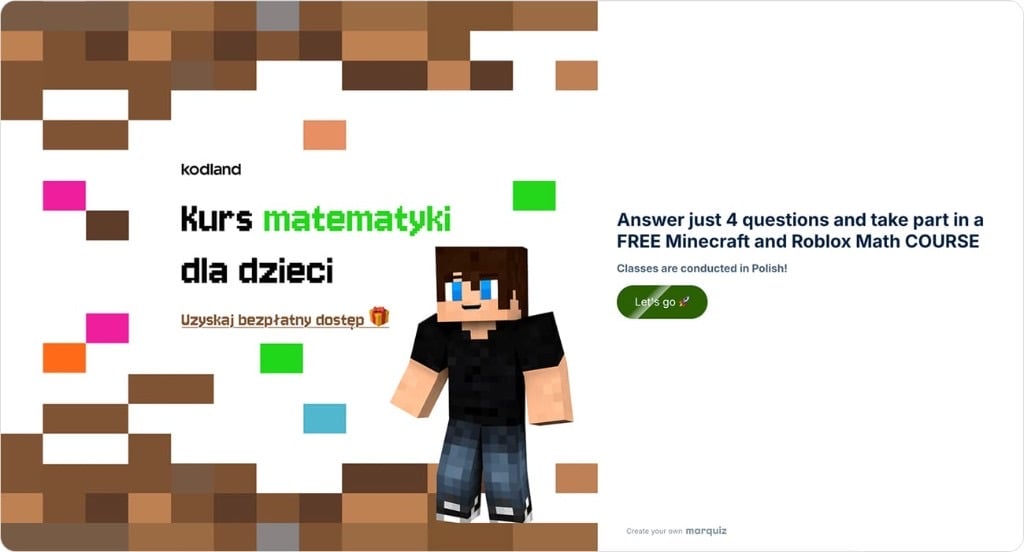
2. Here Kodland takes a school subject that can sound boring to a kid and ties it to a game they already love: Minecraft and Roblox.
The offer works on two levels. For a child, it’s not “another math class” — it’s an activity connected to worlds they already know. For a parent, it’s still an educational product where the child practices math in a familiar game environment.
Kodland doesn’t hide math from the offer — they just lead with the environment kids already enjoy.
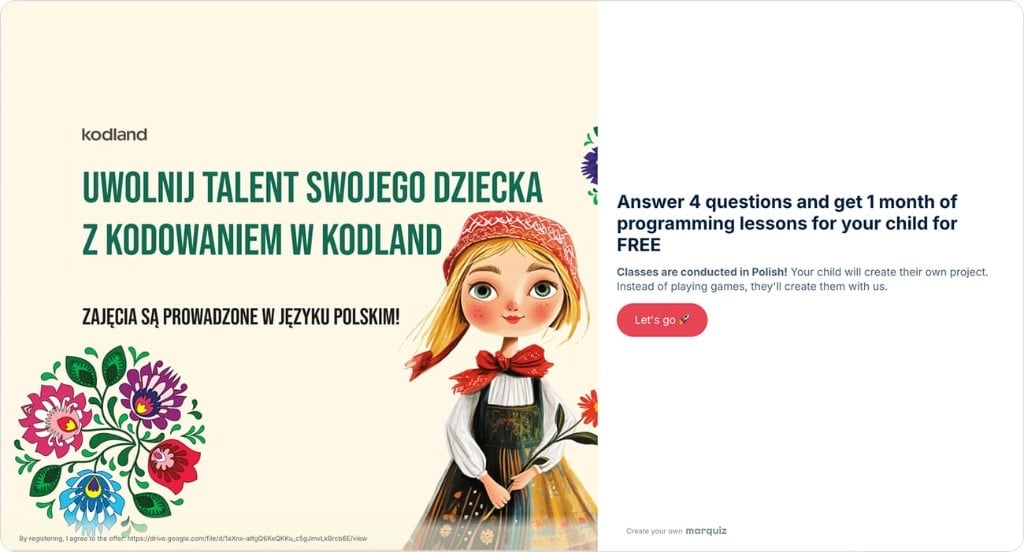
3. This offer speaks to a parent pain point: while playing, the child learns to build games themselves. For the child, it’s a natural extension of their interest. For the parent, it’s a shift from consuming to creating.
In all three examples, Kodland starts with a hook both sides of the deal can understand.
So the offer works as a bridge between what kids want and what parents value: tablet → digital creativity, Minecraft and Roblox → math, games → programming and personal projects.
Want the same funnel for your EdTech product?
Book a short call with Marquiz — we'll walk through your market and funnel, and map out a quiz flow that fits your product.
Book a callTactic №3. Book the trial lesson inside the quiz
The typical EdTech funnel looks like this: quiz collects a contact → a manager calls back → they agree on a time → trial lesson. A huge share of leads drops off along the way: didn’t pick up, changed their mind, couldn’t find a convenient slot.
Kodland took a different route: the quiz ends with picking a specific day and time for a 1:1 trial — not just a phone number.
– Child’s age → filters out irrelevant leads
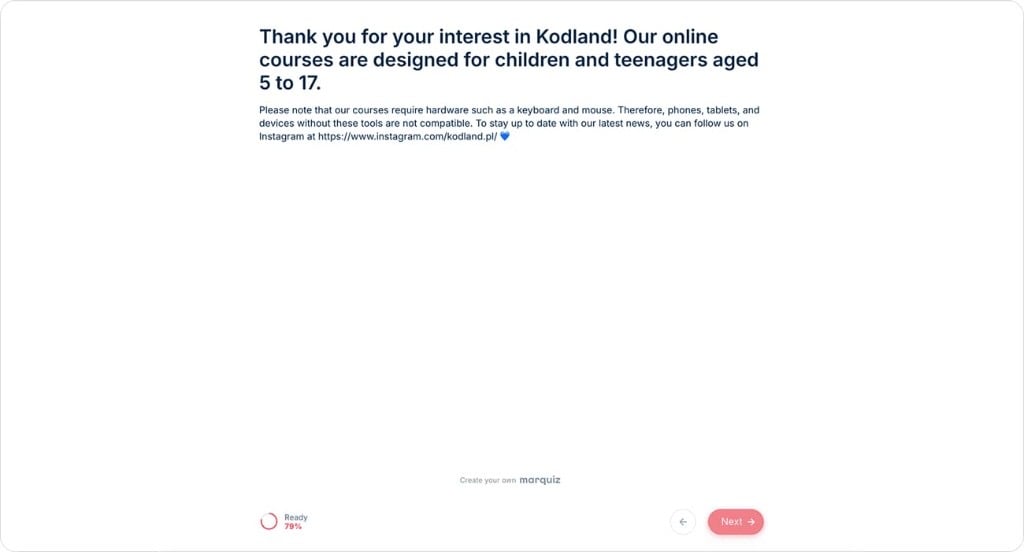
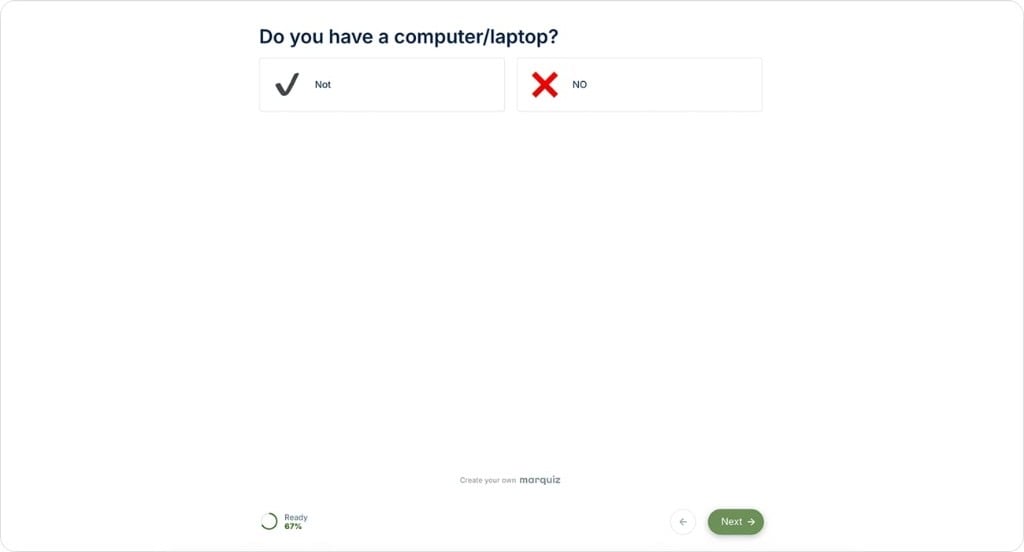
– PC or laptop available → only users who can actually take classes move forward
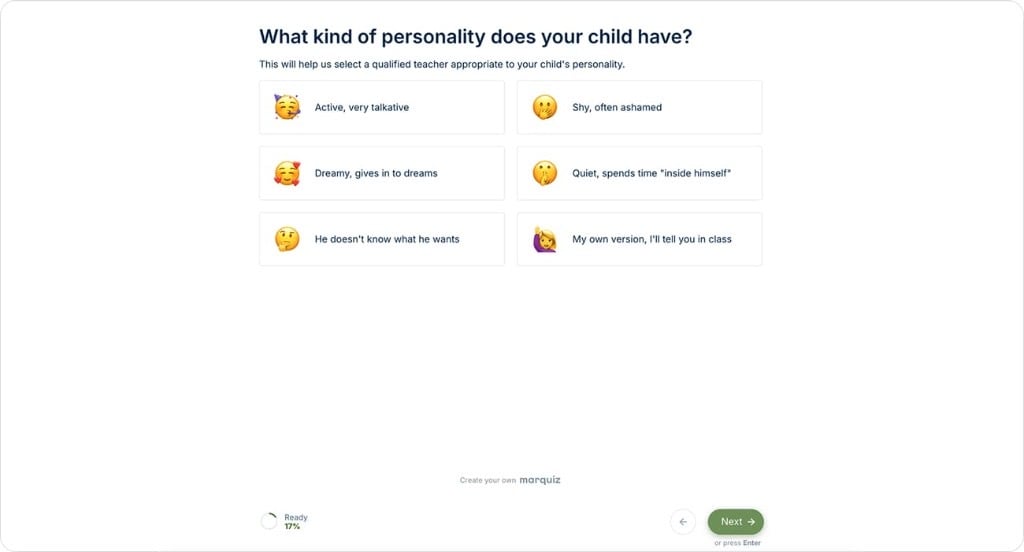
– Child’s personality, motivation, parent priorities → context for the tutor
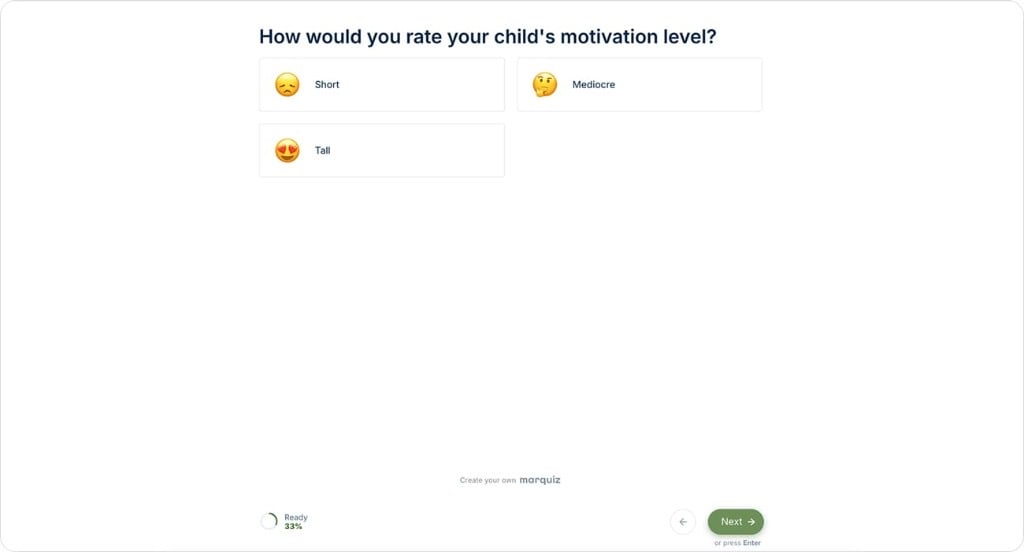
– Group selection → day → time
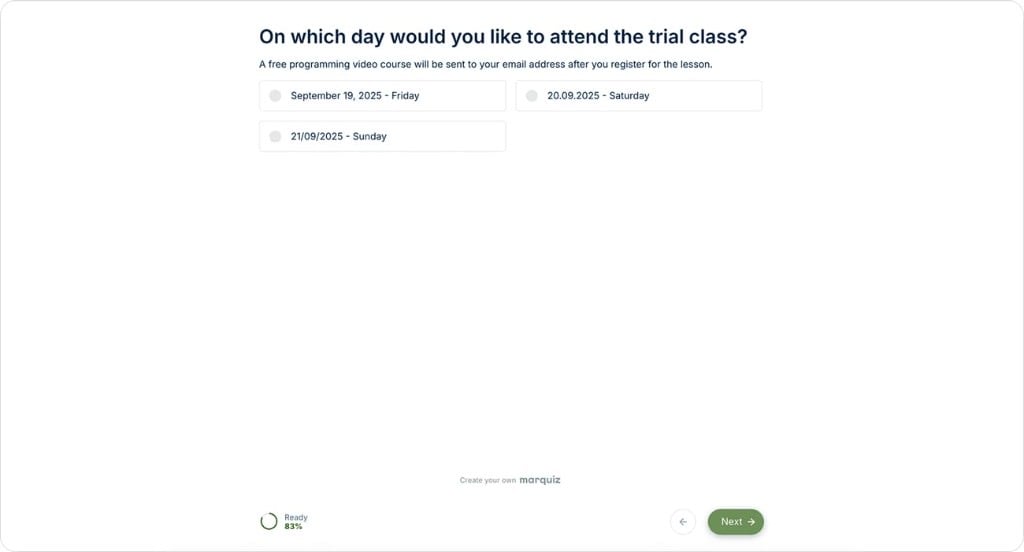
The manager only needs to confirm the slot. In practice, the quiz replaced the call center at the booking stage.
Tactic №4. Match the quiz flow to market maturity
The same product needs a different end goal depending on how warm the market already is.
– Mature market (e.g. Poland): the quiz goes straight to booking — the user picks a specific day and time for a 1:1 trial.
– New market (e.g. LatAm): the quiz leads to a simple first step — a short survey, after which a tutor reaches out, clarifies the request, and suggests the right course.
Kodland scales into new markets and segments audiences with quizzes
Kodland chose not to build one universal quiz for every geo — scale would have eaten precision. Instead, the team builds stacks: market = offer — quiz — creative. Math in Minecraft gets one flow, a złoty scholarship offer gets another, teens get a parent handoff branch, Poland gets booking slots, LatAm gets a tutor call.
Quizzes give Kodland both:
✔️ Scale — launch and test a new hypothesis fast
✔️ Personalization — speak to different segments, warm and cold audiences, mature and emerging markets, long funnels and short ones
The result so far — and the campaign is still running — is the combination of volume and precision: a million leads built on hundreds of quiz funnels. The team hit their lead volume target, and the system has been running steadily for years.
Why quizzes work for EdTech
EdTech products are bought through deliberate choices: learning goals, age, current level, format, schedule, and budget. A quiz walks users through those choices and produces a meaningful lead for sales from day one.
A quiz in EdTech handles several jobs at once:
– Collects context before the call: who’s learning, what outcome they want, starting level, and constraints.
– Improves lead quality: the CRM gets motivation and selection parameters, not just contact details.
– Speeds up the first step: users choose an action right away — trial lesson, consultation, booking slot, or useful content.
– Segments audiences at the entry point: different flows for parents, teens, adult learners, and different markets.
– Boosts conversion through dialogue: users get a relevant path for their request, and the business gets precise segmentation and a stronger lead at the same touchpoint.
– Gives marketing fast experiments: offers, lead magnets, warm-up formats, and entry scenarios are easy to launch and test.
– Makes it faster to enter new countries: you can launch without a separate landing page — through a localized quiz with the right logic, offer, and path to sale.
– Simplifies scaling: one mechanic adapts easily to new geos, offers, and product lines.
A quiz in EdTech is a managed funnel that engages, qualifies, and moves users to the next sales step — all at once.
Want the same funnel for your EdTech product?
Book a short call with Marquiz — we'll walk through your market and funnel, and map out a quiz flow that fits your product.
Book a call